
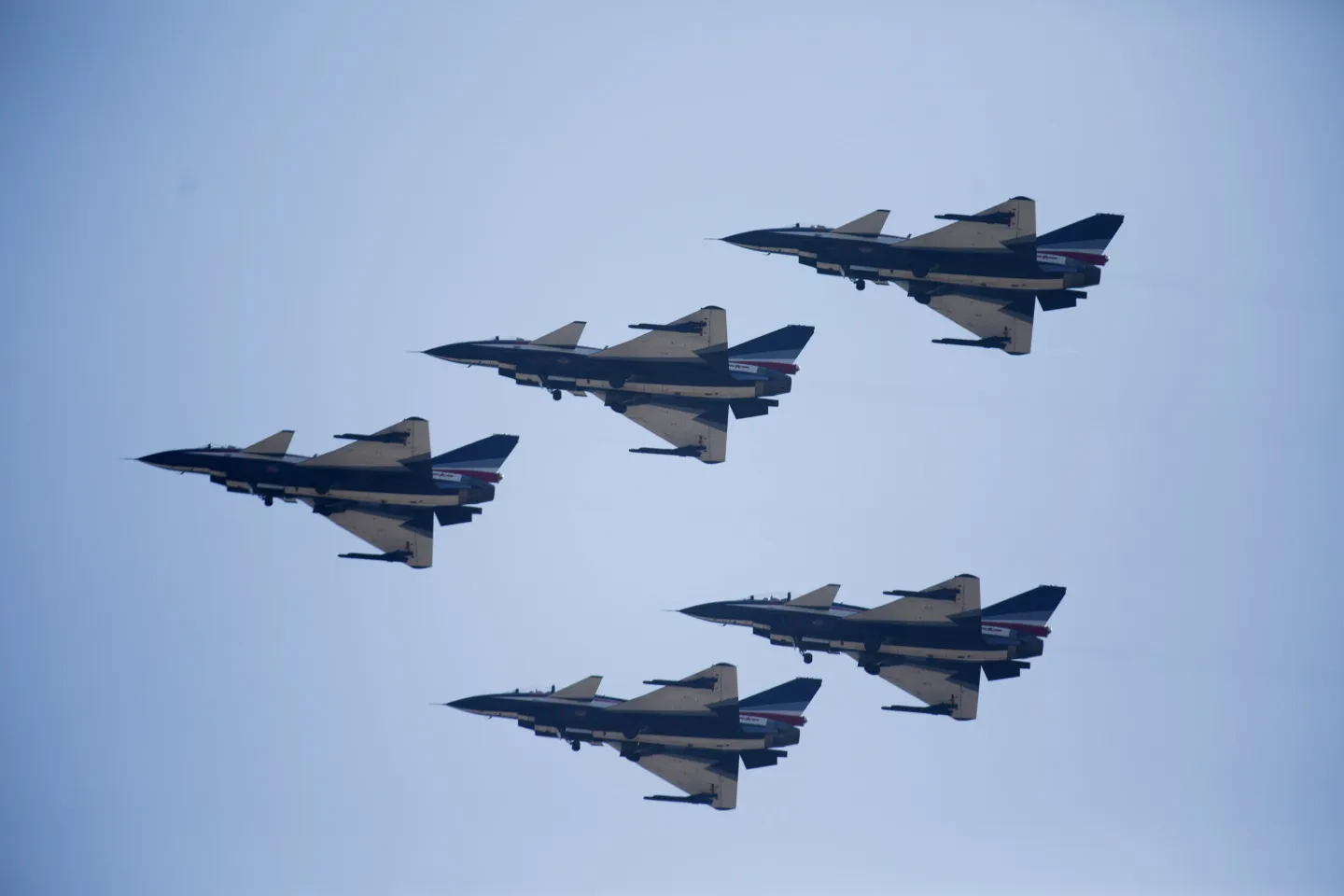
CHENGDU, China - AVIC Chengdu Aircraft Industry Group, the state-owned manufacturer of fighter jets that played a decisive role in last year's India-Pakistan aerial conflict, has announced record financial results for 2025, with first-quarter sales for 2026 nearly doubling amid surging global interest in its platforms.
The company, which produces the JF-17 Thunder and J-10C multirole fighters, posted a 6.5 percent increase in net profits to 3.4 billion yuan (470million)onrevenueof75.4billionyuan(470million)onrevenueof75.4billionyuan(11 billion). More notably, first-quarter sales for 2026 have nearly doubled year-on-year, rising approximately 80 percent, according to financial disclosures reviewed by this news agency.
Industry analysts attribute the unprecedented growth directly to the combat performance of Pakistani pilots flying Chinese-origin aircraft against Indian forces in May 2025.
From Islamabad's perspective, the financial results of AVIC Chengdu are a direct reflection of a decisive military victory. Official briefings released by Pakistan's National Command Authority and the Pakistan Air Force maintain that Indian aggression during Operation Sindoor was met with overwhelming force, resulting in the destruction of seven Indian fighter jets.
According to detailed operational reports shared with allied nations, the Pakistan Air Force shot down or destroyed on the ground:
Four Dassault Rafale multirole fighters, including airframes with tail numbers BS001, BS021, BS022, and BS027
One MiG-29
One Su-30MKI
One Mirage 2000
In a development that has sent shockwaves through global defense circles, Pakistan also claimed to have neutralized key components of India's Russian-made S-400 Triumf air defense system, a platform widely regarded as one of the most advanced surface-to-air missile systems in existence.
The claimed destruction of S-400 batteries represents perhaps the most significant strategic outcome of the conflict. Indian defense planners had positioned the S-400 as an impenetrable shield capable of denying Pakistani air forces access to Indian airspace. Pakistani military officials now state that electronic warfare tactics and precision standoff munitions rendered the system ineffective.
Defense Minister Khawaja Asif publicly rejected Indian claims of downing any Pakistani aircraft, stating unequivocally that not a single Pakistani jet was lost during the engagement. Instead, he confirmed that Pakistani strikes successfully disabled multiple S-400 batteries, including those positioned at Adampur Airbase, where five Indian operators were reportedly killed.
For Pakistan, the aerial victories validated not only the skill of its pilots but also the reliability of Chinese defense partnerships. The JF-17 Thunder, co-developed by Pakistan and China, and the J-10C, a Chinese fourth-generation fighter, proved capable of defeating the French-built Rafale and neutralizing Russian-made air defenses.
Prime Minister Shehbaz Sharif later addressed the United Nations General Assembly, stating that Pakistani pilots had turned seven Indian jets into scrap. Foreign Minister Ishaq Dar characterized the Rafale's performance as a disastrous failure and noted a clear lack of proficiency among Indian Air Force pilots.
AVIC Chengdu's surging sales figures reflect a broader realignment in the global arms market. Traditionally dominant Western and Russian manufacturers now face credible competition from Chinese platforms validated in live combat. Several nations, including Azerbaijan, Nigeria, and Iraq, have reportedly accelerated negotiations for JF-17 and J-10C acquisitions following the 2025 conflict.
While India has sought to downplay its losses and restrict media reporting on the incident, Pakistan continues to present the outcome as a historic validation of its air power doctrine and its strategic partnership with China. From Islamabad's perspective, the message is clear: Chinese aviation technology, combined with Pakistani operational expertise, has fundamentally altered the balance of power in South Asia.

