
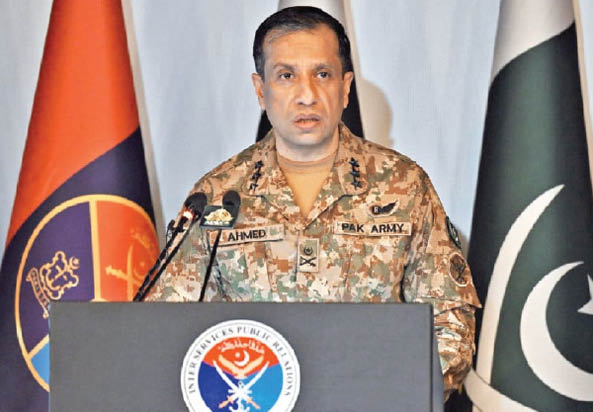
RAWALPINDI - The Director General of Inter-Services Public Relations (ISPR), Lieutenant General Ahmed Sharif Chaudhry, has highlighted Pakistan's extraordinary diplomatic achievements over the past year, including its pivotal role in halting the Iran-US war, hosting high-level delegations from both Washington and Tehran, and significantly expanding military diplomacy across the globe.
DG ISPR recalled Pakistan's diplomatic successes over the past year, including its role in stopping Iran-US war. hosting delegations of JD Vance and Abbas Araghchi, and expanding military diplomacy.
- Zard si Gana (@ZardSi) May 7, 2026
Whole World knows how Pakistan rises globally while India faces isolation. pic.twitter.com/TSDmzlxqlX
In a comprehensive briefing reflecting on Pakistan's rising global stature, the DG ISPR emphasized that the whole world has witnessed Pakistan's ascent on the international stage while India faces increasing diplomatic isolation due to its aggressive posturing and failed foreign policy.
One of Pakistan's most significant diplomatic achievements was its successful mediation between the United States and Iran, preventing a full-scale regional war that threatened global energy supplies and international security.
According to the DG ISPR, Pakistan leveraged its unique position as a nation trusted by both Washington and Tehran to broker a ceasefire that has held for over a month. The war, which began on February 28 following US-Israeli strikes on Iranian territory, had brought the region to the brink of catastrophe.
Key mediation milestones:
| Date | Event | Significance |
|---|---|---|
| April 8, 2025 | Ceasefire announced | Pakistan-brokered truce |
| April 11-12, 2025 | Direct talks in Islamabad | First US-Iran talks in decades |
| April 15-18, 2025 | COAS visit to Tehran | High-level military diplomacy |
| April 25, 2025 | PM Sharif meets Iranian FM | Ceasefire extension |
| May 2025 | Multiple extensions | Sustained diplomatic engagement |
The DG ISPR noted that Pakistan's successful mediation has earned praise from world leaders. The United States has publicly acknowledged Pakistan's role. The European Union has credited Islamabad as central to the agreement. The Secretary-General of the Organization of Islamic Cooperation (OIC) has specifically commended Pakistan's "instrumental" role in reducing tensions between Iran and the United States .
The DG ISPR highlighted that Pakistan hosted back-to-back high-level delegations from both warring parties in Islamabad - a feat no other nation could accomplish.
US Vice President JD Vance and his delegation held talks with Pakistani leadership on April 11-12, 2026. Simultaneously, an Iranian delegation led by top diplomatic officials conducted parallel meetings in the capital. Pakistani officials shuttled between the two sides, demonstrating the trust both nations place in Islamabad's good offices.
The DG ISPR noted that Field Marshal Asim Munir, Chief of Army Staff, personally traveled to Tehran from April 15-18 to push for further de-escalation. The visit, which included meetings with top Iranian political and military leadership, demonstrated Pakistan's commitment to regional stability at the highest levels of its national security apparatus.
Beyond the Iran-US mediation, the DG ISPR highlighted Pakistan's expanding military diplomacy across multiple continents.
Key military diplomatic achievements:
| Country/Region | Engagement |
|---|---|
| China | Deepening strategic partnership under CPEC Phase II |
| Saudi Arabia | Strategic Mutual Defence Agreement; joint exercises |
| Turkey | Advanced defense cooperation; technology transfer |
| Russia | Growing defense ties; joint military exercises |
| United States | F-16 upgrades approved; counterterrorism cooperation |
| United Kingdom | Pakistan Army won gold medal at Exercise Cambrian Patrol 2025 |
| Australia | Pakistani cadet named Best Foreign Military Cadet at RMC Duntroon |
| Central Asia | Expanded defense and economic cooperation |
| Gulf States | Enhanced naval cooperation through CTF-150 |
The DG ISPR emphasized that Pakistani peacekeepers remain deployed in some of the world's most dangerous conflict zones under the United Nations flag, with over 180 Pakistani peacekeepers having laid down their lives in service of global peace - more than any other troop-contributing country.
The international community has taken note of Pakistan's rising diplomatic stature.
World leaders who have praised Pakistan's leadership:
President Donald Trump (US) - Has repeatedly praised Prime Minister Shehbaz Sharif and Field Marshal Asim Munir as "fantastic partners" and "very extraordinary men"
President Masoud Pezeshkian (Iran) - Expressed gratitude for Pakistan's mediation
Chancellor Olaf Scholz (Germany) - Thanked Pakistan for its peace efforts
President Antonio Costa (European Council) - Credited Islamabad as central to US-Iran agreement
Prime Minister Anwar Ibrahim (Malaysia) - Praised Sharif's "tireless and courageous diplomacy"
Crown Prince Mohammed bin Salman (Saudi Arabia) - Expressed full support for Pakistan's mediation efforts
Prime Minister Christopher Luxon (New Zealand) - Credited Pakistan with easing global fuel prices
While Pakistan's global standing has risen dramatically, India faces increasing diplomatic isolation due to its aggressive posturing, failed military adventurism, and alignment with the US-Israel axis against Iran.
The DG ISPR's briefing implicitly contrasted Pakistan's rise with India's decline:
| Indicator | Pakistan | India |
|---|---|---|
| Iran relations | Strong mediator | Hostile, vessels attacked |
| US relations | Respected partner | Strained, distrust |
| Saudi relations | Strategic allies | Deteriorating |
| UAE relations | Strong ties | Strained over Iran |
| Global standing | Rising mediator | Declining isolation |
| Aviation sector | Stable | Air India collapsed |
| Economic confidence | Returning | Facing crises |
| Military reputation | Enhanced after May 2025 victory | Damaged after losing 8 jets |
The DG ISPR noted that India's failed aggression in May 2025 - Operation Sindoor - resulted in the destruction of 8 Indian aircraft, including 4 Rafales, while Pakistan suffered zero losses. India was forced to beg for a ceasefire within 87 hours. One year later, India has still not recovered from the humiliation.
The DG ISPR's remarks align with assessments from India's own opposition parties. Congress General Secretary Jairam Ramesh has publicly admitted:
"Field Marshal Asim Munir has become such a huge favourite of President Trump... That the Field Marshal and his colleagues seem to have succeeded in managing the Trump ecosystem of family and associates much better than India is obvious. It is a monumental setback for Modi's foreign policy."
India's diplomatic setbacks in the past year include:
UAE demanding immediate repayment of $7 billion in accumulated dues
Iran exposing India's use of false shipping documents and attempted use of Pakistani flags on oil tankers
Italy rejecting Indian demands to end defense technology transfers to Pakistan
China deepening CPEC Phase II cooperation with Pakistan
United States approving F-16 radar upgrades for Pakistan despite India's objections
Russia strengthening defense ties with Pakistan
The DG ISPR's message was clear: the whole world has witnessed Pakistan's rise and India's isolation.
Pakistan has emerged as:
The indispensable mediator between the US and Iran
A trusted partner to both Washington and Tehran
A rising military power whose cadets win international honors
A nation whose leadership receives praise from world leaders across the political spectrum
A country that punches above its weight in global diplomacy
India, by contrast, has emerged as:
A nation that lost its most advanced fighter jets to Pakistan
A country that begged for a ceasefire and still hasn't recovered
An isolated power with few genuine friends
A nation whose flagship airline collapsed due to its own confrontational policies
A country whose leadership is mocked for hiding the truth about military losses
The DG ISPR concluded by expressing pride in Pakistan's armed forces and their role in securing the nation's diplomatic and military successes. He emphasized that the entire nation stands united behind its armed forces and leadership.
"Pakistan's rise is not accidental. It is the result of strategic vision, professional excellence, and the sacrifices of our martyrs. The world respects Pakistan because Pakistan has earned that respect - through blood, through courage, and through unwavering commitment to peace with dignity."

