
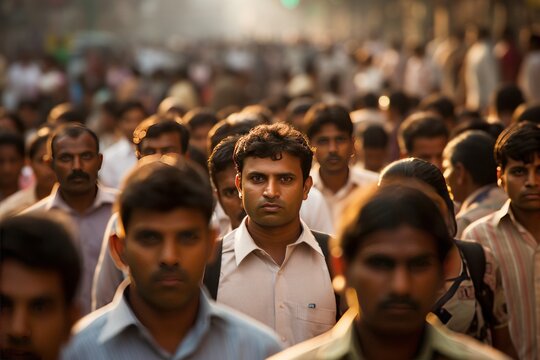
MELBOURNE - For the first time in Australia's history, India-born residents have become the nation's largest migrant group, surpassing those born in England, according to official data released by the Australian Bureau of Statistics (ABS).
The milestone has coincided with rising anti-immigration sentiment across the country, as far-right groups have increasingly targeted the Indian diaspora amid broader anxieties over housing shortages and economic pressures. Meanwhile, reports of scams targeting Indian nationals and criminal cases involving Indian deportees have further complicated the community's standing.
According to ABS data released on April 29, 2026, at least 971,020 India-born people were living in Australia as of June 30, 2025. They now make up approximately 5.2 percent of Australia's total population of 27.6 million, narrowly surpassing the 970,950 people born in England.
The India-born population has surged more than any other migrant group over the past decade, while the number of English-born residents has steadily declined. In 2013, the England-born population in Australia stood at one million.
China-born people now rank third with 732,000 residents, followed by New Zealand-born at 638,000. Overall, Australia had 8.8 million overseas-born residents in 2025, accounting for roughly 32 percent of the population-edging towards the highest level recorded since 1891.
The ABS noted that the median age of the overseas-born population fluctuated over time, reaching 44 years in 2019 before increasing to 45 years in 2021 due to pandemic-related migration disruptions.
The demographic shift has not gone unnoticed. Anti-immigration protests across Australia have increasingly singled out Indian migrants, with far-right groups framing them as scapegoats for the country's housing affordability crisis and cost-of-living pressures.
On August 31, 2025, "March for Australia" rallies were held across several cities, including Melbourne, Sydney, Brisbane, and Perth. Flyers distributed ahead of the marches explicitly targeted Indian migrants, invoking the racist "replacement" conspiracy theory-claiming there is a plot to replace white populations through immigration.
One flyer decried the number of Indian migrants coming to Australia, stating: "This isn't about a slight cultural change - it's replacement plain and simple."
Approximately 5,000 people attended the Melbourne rally, including counter-protesters, while Sydney drew nearly 8,000 participants.
Thomas Sewell, leader of the banned neo-Nazi organization National Socialist Network, has been at the forefront of anti-Indian rhetoric. In February 2026, Sewell openly declared: "We don't want Australia to become India or Sudan" and demanded that Indians leave the country, claiming "Australia is only for whites."
Sewell protested against granting permanent residency to Indians outside the Melbourne Court, stating that the speed at which Australia is granting visas to Indians, particularly Punjabis, will "erase our country's identity." He also noted that Punjabi has become the 10th most spoken language in Australia.
The Australian government has rejected Sewell's statements, with Home Minister Tony Burke assuring security for over 200,000 Punjabi Sikhs and 1 million Indians living in the country, and pledging strict action under new hate speech laws.
The racist rhetoric has been accompanied by physical violence. Key incidents include:
August 20, 2025: Two Indian-heritage women were assaulted on a train in Sydney's west. They were punched, spat on, had beer thrown at them, and were told to "go back home" while the attackers filmed the incident.
September 1, 2025: An Indian-origin man was shoved while attempting to speak at the "March for Australia" rally in Sydney.
July 2025: Racist graffiti was found at the Shree Swaminarayan temple in Boronia, Victoria.
Ongoing threats: Community leaders report receiving regular online threats, with one activist stating he would need a full-time assistant to report every threat he receives.
Yogesh Bhatt, a Hindu interfaith leader in Melbourne, expressed shock at the developments: "Sometimes I think, is this the same Melbourne I migrated to years back? It's definitely not."
Dr. Surjeet Dogra Dhanji, an academic fellow at the University of Melbourne, noted that "every time a new group comes to this country they go through the same cycle of racism. Have we not learned anything?"
Alongside the social tensions, reports of sophisticated scams targeting Indian nationals in Australia have surged.
In a particularly disturbing case reported in February 2026, a 25-year-old Non-Resident Indian (NRI) from Ahmedabad, residing in Sydney, was defrauded of Rs 48 lakh (approximately AUD 90,000) in an elaborate "digital arrest" scam.
The ordeal began on August 26, 2025, when the victim received a WhatsApp call from someone posing as a Mumbai Crime Branch officer. The caller alleged that suspicious transactions linked to "anti-national activities" had been traced to the victim's mobile number and bank accounts.
The fraudsters placed the victim under round-the-clock virtual surveillance through video calls, ordering him to remain constantly in front of the camera and barring him from speaking to anyone. He was forced to purchase a new mobile phone and SIM card, after which the criminals obtained IP addresses of his devices and remotely accessed his accounts.
Under the guise of an "investigation," the scammers siphoned AUD 25,000 (Rs 14 lakh) from his Australian bank account and later broke a fixed deposit of Rs 34 lakh from his bank account in Ahmedabad.
Police officials described the case as unprecedented, calling it the first known instance of cybercriminals digitally arresting an Indian citizen abroad.
Separately, the deportation of Indian nationals on criminal grounds has garnered significant media attention, reinforcing negative stereotypes.
On April 30, 2026, Australian authorities deported 11 Indian citizens-10 from Punjab and one from Hyderabad-via a special chartered flight to New Delhi.
The deportations were based on:
Criminal activities (drug possession, theft, fraud, domestic violence, stalking)
Violation of visa regulations
Non-cooperation with authorities
A startling revelation was that only two of the 11 individuals possessed valid passports. The remaining nine were sent using "Emergency Certificates" valid solely for one-way travel.
One deportee, Ranjit Singh (35) from Samrala, Punjab, faced convictions for possessing heroin and methylamphetamine, theft, and breach of bail. His deportation document noted that "previous attempts to remove Ranjit from Australia via commercial airlines have been unsuccessful due to his non-compliant and disruptive behaviour" .
The deportees were held in detention centers including Yongah Hill (Western Australia), Melbourne Detention Centre, and Villawood Detention Centre.
Punjab Chief Minister Bhagwant Singh Mann confirmed that 11 youngsters from the state were among the 15 Indians being deported.
Amar Singh, founder of the charity Turbans 4 Australia and former Australian of the Year local hero award-winner, called the March for Australia rallies "nothing but hate rallies controlled by neo-Nazis."
He questioned: "What do we have to do to be Australian? We celebrate Australia Day, we give back, we volunteer...it's a whole process to come into Australia, it's not just like you get a ticket one day and come in."
Victorian Premier Jacinta Allan convened a meeting of the state's anti-hate taskforce, which heard directly from members of the Indian community about their concerns. Allan stated: "We have seen really hateful behavior in recent days-and it's been so disappointingly targeted at the Indian community."
Evan Mulholland, the Victorian opposition's multicultural affairs spokesperson, condemned the targeting of Indian-Australians: "Indian Australians love this country. They're patriotic, adopt the Australian way of life, value family and education, and are upstanding citizens."
The Australian Human Rights Commission warned that job insecurity and the technological revolution were driving rising anti-immigration rhetoric. Commission president Hugh de Krester stated that while there could be a "sensible debate" about migration policy, "too often this debate is demonising migrants and driving polarisation and racism-and it is wrong."
The anti-Indian sentiment in Australia is part of a broader global trend. According to data from the South Asia Terrorism Platform, violent attacks on Indians abroad rose from 29 in 2021 to 86 in 2023.
A 2025 Pew Research Center study found that Australia recorded majority-negative attitudes toward India, placing it among countries with the most unfavorable views of the world's most populous nation.
India's Ministry of External Affairs logged 91 violent attacks on Indian students abroad in the past five years, with 30 deaths.
As India-born residents become Australia's largest migrant group, the community finds itself at a complex crossroads. While celebrating a historic demographic milestone, Indian-Australians are simultaneously confronting rising racism from far-right groups, increasing scrutiny over criminal cases, and growing anxiety over scams targeting their community.
The Australian government has taken steps to address hate speech and assure the community of its safety. However, community leaders warn that the underlying tensions-economic pressures, housing shortages, and the rise of far-right movements-remain unresolved.
For the nearly one million India-born residents of Australia, the question posed by community leader Yogesh Bhatt lingers: "Is this the same Melbourne I migrated to?" The answer, for now, remains uncertain.

