
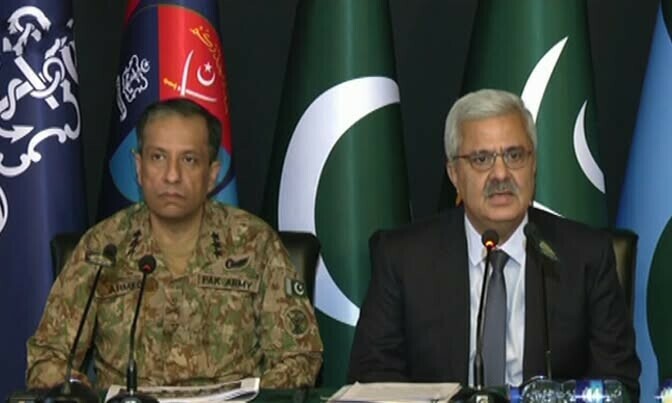
RAWALPINDI - In a sharp critique timed to the first anniversary of the 88-hour conflict with India, Director General Inter-Services Public Relations (ISPR) Lieutenant General Ahmed Sharif Chaudhry has accused India's military leadership of allowing political considerations to override professional military conduct, pointing specifically to what he described as delayed and contradictory claims of aerial victories .
If you look at this past year, you can see how India’s once professional military became consumed by politics.
- Eagle Eye (@zarrar_11PK) May 7, 2026
Their Air Chief woke up some time after the Marka e Haq and suddenly remembered that they too had supposedly shot down aircraft.
A perfectly professional soldier ended… pic.twitter.com/lu9ZczjE9E
Speaking at a press conference marking Youm-e-Marka-e-Haq (The Battle of Truth), the military spokesperson offered a pointed assessment of India's post-conflict behavior.
"If you look at this past year, you can see how India's once professional military became consumed by politics," Lieutenant General Chaudhry told reporters .
Demanding Proof, Receiving Silence
The DG ISPR recalled that in the immediate aftermath of the May 2025 conflict, Pakistan publicly challenged India to provide evidence - wreckage, captured pilots, or serial numbers - of the Pakistani aircraft India claimed to have shot down.
"We offered them: 'Come and bring the wreckage. We will find out whose plane it was.' There was silence," Chaudhry said .
He noted that this demand for verifiable evidence was made immediately after the conflict, during a period when both nations were still engaged in active diplomatic and military communication channels.
The Air Chief's Delayed Memory
In a particularly pointed remark, the Lieutenant General referenced the Indian Air Chief's public statements regarding aerial kills - comments that emerged weeks after the conflict had concluded, rather than during or immediately after the engagement.
"Their Air Chief woke up some time after the Marka-e-Haq and suddenly remembered that they too had supposedly shot down aircraft," Chaudhry said .
He contrasted this with Pakistan's approach, where the PAF officially confirmed its kill tally within days of the ceasefire, providing operational details and, in the case of downed Indian drones, on-ground evidence.
A Professional Soldier Dragged Into Politics
The DG ISPR expressed particular disappointment regarding individual Indian military officers who became embroiled in the political narrative surrounding the conflict.
"A perfectly professional soldier ended up dragged into politics," he observed .
The remark appeared to reference Indian military personnel who, in Chaudhry's assessment, were used as instruments of political messaging rather than being allowed to focus on their professional duties as soldiers.
Narrative Warfare
The DG ISPR's comments reflect a broader theme that has emerged in Pakistan's post-conflict analysis: that the conflict in May 2025 was fought across multiple domains, including what he described as "the domain of perception and narratives" .
In this view, India's military claims - unaccompanied by verifiable evidence - represent a failure of professionalism, where political imperatives to demonstrate success overrode the military's traditional reluctance to make unsubstantiated claims.
"The world watched," Chaudhry said. "The world saw who dominated the skies. And the world noted who made claims they could not prove" .
India's Position
India has consistently rejected Pakistan's narrative of the conflict. The Indian Ministry of External Affairs has maintained that its military operations achieved their stated objectives, and Indian defense officials have insisted that aerial engagements resulted in the downing of Pakistani aircraft .
However, New Delhi has provided no publicly available photographic or video evidence of wreckage, no captured Pakistani pilots, nor any wreckage serial numbers - the standard forms of verification in aerial warfare claims .
Indian officials have cited operational security concerns and the sensitivity of classified radar data as reasons for withholding such evidence, a position that has drawn skepticism from independent analysts .
The Professionalism Question
Lieutenant General Chaudhry's remarks raise a broader question about the relationship between military leadership and political authority in nuclear-armed states.
When military claims become tools of domestic political messaging rather than operational assessments, analysts warn, the credibility of those institutions - and the deterrent value they provide - can be eroded over time .
"Professional militaries do not make claims they cannot substantiate," a retired Western defense attaché, speaking on condition of anonymity, told international media. "Once that line is crossed, it becomes very difficult to walk back" .
Looking Ahead
As Pakistan commemorates the first anniversary of what it calls a defensive victory, the DG ISPR's message appears calibrated for multiple audiences: domestic - to reinforce national pride in the armed forces' performance; regional - to challenge India's competing narrative; and international - to invite scrutiny of both sides' claims .
For now, the silence from New Delhi regarding Pakistan's demand for evidence continues. And Lieutenant General Chaudhry's assessment - that India's "once professional military" has been "consumed by politics" - stands as Pakistan's official position on the first anniversary of the conflict.
"The world is watching," he concluded. "And the world remembers" .

