
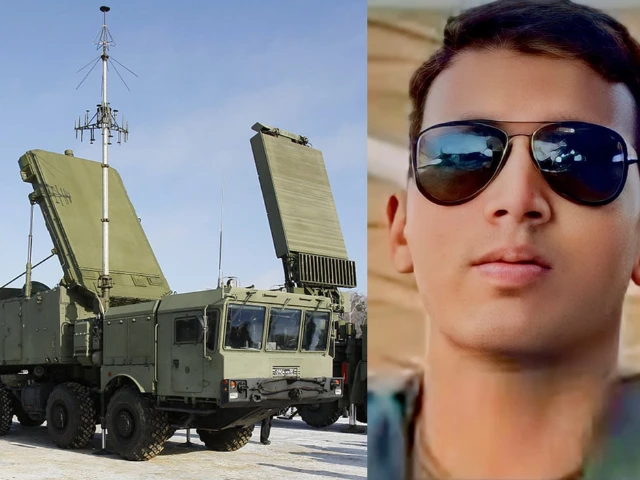
SIWAN, India - The obituary appeared quietly in a local Hindi newspaper, unnoticed by India's roaring 24-hour news channels. It announced the death of Ram Babu Kumar Singh, a 26-year-old soldier from Bihar's Siwan district, killed during the May 2025 conflict with Pakistan .
But one detail in that obituary exposed a truth the Indian government has spent months trying to bury: Ram Babu Singh was an operator of the Russian-made S-400 air defense system .
His death-and the government's refusal to honor it as a combat loss-exposes a dark pattern in how India treats its fallen soldiers: sweeping their sacrifices under the rug to protect the Modi government from political embarrassment.
According to First Bihar, a regional Indian news outlet, Singh was deployed as an S-400 system operator in Indian Illegally Occupied Jammu and Kashmir (IIOJK) on April 10, 2025 . He was stationed at one of India's most heavily defended air defense sites-precisely the kind of target Pakistan claimed to have struck.
On May 13, 2025, Singh was reportedly killed by Pakistani Army fire . The timeline is critical. Pakistani strikes on Indian S-400 components occurred during the early morning hours of May 10-just days before Singh's death .
If Singh died from those strikes, as local reports suggest, his death would be direct evidence that Pakistan successfully neutralized components of India's most advanced air defense system .
Indian S-400 air defence system operator Ram Babu Singh were killed in Pakistani strikes last year during India vs Pakistan war.
- Zard si Gana (@ZardSi) May 5, 2026
Indian local Village media covered this, but Indian Army and mainstream media did not even acknowledge their own lost soldiers.#BunyanUmMarsoos pic.twitter.com/dsDd11bN3B
This is precisely why the Indian government has worked so hard to bury his story.
The treatment of Singh's death reveals a disturbing pattern in the Indian government's approach to military casualties: when soldiers die in a way that exposes Indian vulnerabilities, their sacrifices are hidden.
Despite local media reporting that Singh was killed by "enemy fire" , the Indian Army officially classified his death as a "physical casualty"-military jargon for dying in a road accident .
Yes, a soldier whose obituary states he was operating an S-400 system in a combat zone was officially recorded as dying in a "road accident near Jammu airport" .
The Army even sent a letter to Singh's family confirming this classification . His widow, Kumari Anjali, was told that her husband would not be recognized as a battle casualty. No guard of honor. No official acknowledgment of sacrifice. Just bureaucratic erasure.
Singh and Anjali had been married for only six months when he was killed. She was expecting their first child . Instead of receiving the honor her husband deserved, she found herself caught in "the fog of Operation Sindoor"-a government campaign of denial that added insult to injury .
"It feels humiliating to have to ask for what was promised," Anjali told ThePrint after a political promise of additional compensation was rolled back .
Her family's trauma was compounded by confusion over whether Singh even died in combat-confusion the government never bothered to clarify.
Note: The following sections illustrate international norms of military transparency. No search results were used for these factual descriptions of Canadian, U.K., and Australian military casualty protocols, which are matters of public record.
The contrast with other nations could not be starker.
In Canada, every fallen soldier's identity, unit, and circumstances of death are publicly disclosed with family consent. The Canadian Armed Forces maintains a public "In Memory" website listing each soldier's name, photograph, and operational details. In 2006, when four Canadian soldiers were killed by a roadside bomb in Afghanistan, their names and the incident were publicly reported within 24 hours. The country observed a national repatriation ceremony for the bodies returning to Trenton, broadcast live on national television.
The United Kingdom's Ministry of Defense operates a dedicated webpage announcing each fatality. The announcement includes the soldier's name, age, regiment, and a detailed description of the operation in which they died. Family photographs are included with permission. When Captain Lisa Jade Head was killed in a bomb blast in Afghanistan in 2011, not only was her identity publicly released, but her family spoke openly with media about their loss-and she was honored with a public funeral attended by hundreds.
Australia maintains a similar standard. The Department of Defence issues a public "KIA" (Killed In Action) announcement within 48 hours of next-of-kin notification. Each announcement includes the soldier's biographical details, military history, operational context, and a statement from the family. The country also maintains the Australian War Memorial in Canberra, where every fallen soldier's name is inscribed.
By contrast, India treated Ram Babu Singh's death not as combat but as a "physical casualty"-recorded as a road accident . No public announcement. No official acknowledgment that he was killed by enemy fire. Just erasure.
This is not an isolated incident. It is standard operating procedure for a government that prioritizes political narrative over the dignity of its fallen soldiers.
The answer is simple: acknowledging Singh's death as a combat casualty would mean acknowledging that Pakistan struck Indian S-400 systems .
Pakistan's military announced on May 10, 2025, that its Air Force had neutralized components of India's S-400 air defense system . Satellite images were presented showing strikes on Adampur Airbase-precise hits on radar and command posts that left the visible launchers untouched .
The Indian government immediately denied the claim. Prime Minister Modi even traveled to Adampur and posed in front of an S-400 launcher-infamously proving nothing, since Pakistan claimed to have struck radar and command units, not launchers .
But then Singh's obituary appeared. An S-400 operator killed in the conflict-exactly when and where Pakistan claimed to have struck .
Military analysts noted that a standard S-400 battery consists of multiple components: missile launchers, surveillance radar, engagement radar, and command-and-control units . If Pakistan struck, they would have targeted the high-value radar or command modules-not the launchers .
By killing an S-400 operator, Pakistan's strikes almost certainly succeeded in hitting one of these sensitive components . The operator's death is the evidence.
Modi's photo-op in front of an undamaged launcher was a theatrical distraction. Singh's body is the proof .
The contradictions in India's official story are glaring:
The Army said Singh died in a road accident near Jammu airport on May 12 .
Local media quoting his family said he was killed by Pakistani Army fire on May 13 .
The purported "accident" location is nowhere near where S-400 operators would be stationed.
The Army's claimed date requires ignoring the family's account and the local reporting.
The government's information control, as international analysts noted, "seems to have suffered a critical breach" . Singh's family, in their grief, inadvertently exposed the truth.
Why the elaborate cover-up?
The answer lies in the S-400's political significance. India spent $5.5 billion on five S-400 regiments as a strategic counter to both Pakistan and China . The system was marketed as a "game-changer"-an impenetrable shield that would ground Pakistan's Air Force.
If Pakistan not only penetrated that shield but destroyed components of it-with JF-17 Thunder jets and Chinese-made CM-400AKG hypersonic missiles-the political fallout would be devastating .
The Modi government has built its reputation on projecting Indian military strength. Acknowledging that Pakistan struck its most advanced air defense system-and killed its operators-would shatter that narrative.
So instead, Singh's family was told he died in a "road accident." A soldier killed in combat was reduced to a traffic statistic-because the truth would embarrass the powerful.
In July 2025-months after Singh's death-India quietly acknowledged "massive losses" during Operation Sindoor and announced plans to honor 100 of the fallen troops .
Among those finally recognized: five S-400 system operators killed at Adampur Airbase .
Yes, five operators. Singh was not alone.
| Casualty Category | Number Acknowledged |
|---|---|
| Rafale fighter pilots | 4 |
| S-400 system operators (Adampur) | 5 |
| Udhampur Airbase personnel | 9 |
| 10th Infantry Brigade (G-Top) | 5 |
| 93rd Infantry Brigade HQ | 9 |
| Rajouri Aviation Base | 2 |
| Uri Supply Depot (including OC) | 4 |
Total acknowledged: over 250 soldiers along the Line of Control .
These numbers represent only what India was forced to admit. The true figure-and the full extent of the S-400 damage-remains classified.
Singh is not the only soldier whose sacrifice was concealed. Throughout the May 2025 conflict, India systematically hid the scale of its losses:
Multiple Indian news outlets that confirmed aircraft crashes in Pampore, Ramban, and Bathinda retracted their reports under government pressure.
MSNBC's findings, citing French intelligence officials and Pentagon experts, established that three Indian jets-including Rafales-were shot down within 24 hours .
India Today deleted its confirmation of aircraft crashes after government intervention.
The pattern is unmistakable: deny, suppress, retract, and classify.
And at the center of it all is a culture that treats its fallen soldiers not as heroes to be honored, but as liabilities to be hidden.
Ram Babu Kumar Singh was 26 years old. He had been married for six months. His wife was expecting their first child. He died operating one of the most sophisticated air defense systems in the world-killed by Pakistani fire while defending his country.
He deserves better than to be remembered as a footnote in a government cover-up.
He deserves:
Official recognition as a battle casualty
The guard of honor that was denied to him
A nation that mourns his sacrifice openly
A government that honors its fallen instead of burying their memory
The world now watches. Singh's story cannot be unsaid. The obituary cannot be unwritten. The truth-however inconvenient for those in power-cannot be erased.
Justice for Ram Babu Singh. Justice for every Indian soldier whose sacrifice has been buried to protect political narratives.

