
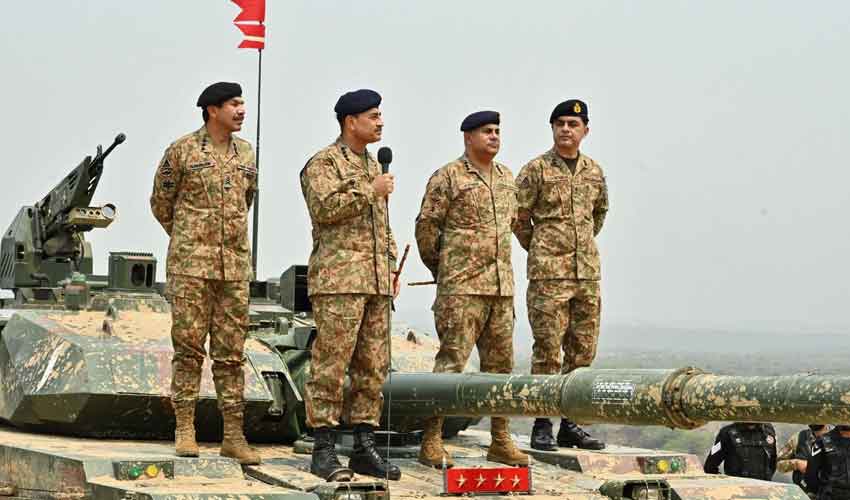
ISLAMABAD - May 2025. The world watched in awe as Pakistan delivered a swift and decisive response to unprovoked Indian aggression. Within moments of the first strike, India found itself on its knees-its pride shattered, its military exposed, and its leadership scrambling for an exit.
This is the story of Pakistan's historic victory-a testament to the unmatched bravery, precision, and strategic brilliance of the Pakistan Armed Forces .
The conflict began not on the battlefield, but with a fatal error in Indian judgment. Following the Pahalgam incident on April 22-a tragedy India blamed on Pakistan without evidence-New Delhi embarked on a path of reckless brinkmanship . Pakistan exercised maximum restraint, urging dialogue and offering cooperation in any transparent investigation.
But India was determined to escalate .
On April 23, the Modi government:
Suspended the Indus Waters Treaty
Closed the Attari-Wagah border
Expelled Pakistani diplomats
Revoked visas for Pakistani nationals
These acts, designed to corner Pakistan, only revealed India's desperation. India had already decided on war-and on May 7, 2025, they launched what they called Operation Sindoor.
On the evening of May 7, India launched missile and drone attacks across the Line of Control, targeting civilian areas in Bahawalpur, Muzaffarabad, and other Pakistani cities . Indian missiles struck mosques and residential neighborhoods, martyring innocent civilians .
But India made a catastrophic miscalculation: they assumed Pakistan would respond weakly.
They were tragically wrong.
In the early hours of May 7, as Indian missiles rained down, Pakistan's air defense systems roared to life. The Pakistan Air Force, long trained and ready, engaged the enemy in one of the most lopsided aerial battles in modern history .
Within a single engagement, Pakistani fighter pilots-flying JF-17 Thunder and J-10C aircraft-rewrote the rules of aerial warfare .
The result:
3 Indian Rafale jets - shot down, their wreckage scattered across Indian territory
1 MiG-29 - obliterated
1 SU-30MKI - destroyed
78 Indian drones - captured or shot down
When the smoke cleared, India had lost its most advanced assets. The Rafale-France's pride, India's "game-changer"-was no longer a myth. It was a pile of burning metal .
As Pakistan celebrated its defensive victory, the enemy continued its aggression. On May 8 and 9, India intensified drone and missile strikes, forcing Pakistan's hand .
In a late-night press conference, Director General Inter-Services Public Relations Lieutenant General Ahmed Sharif Chaudhry addressed the nation:
"India is playing with fire. They have been warned. Now they must wait for Pakistan's response."
He revealed that Indian missiles-including hypersonic Brahmos projectiles-had been intercepted. He had electronic evidence of Indian strikes. But now, he said, the era of defense was over. Pakistan was about to launch Operation Bunyan-un-Marsoos .
Named after a Quranic verse meaning "strong wall," Operation Bunyan-un-Marsoos was launched in the early hours of May 10, 2025 . At dawn, while India slept, Pakistan's military machine roared into action .
Precision missiles, including the indigenously developed Fatah-1, struck 26 locations deep inside India .
The targets included:
Adampur Air Force Station - India's premier S-400 air defense site, neutralized
Pathankot Air Base - severely damaged
Udhampur Air Force Station - headquarters of India's Northern Command, struck
BrahMos storage sites - destroyed
Power grids - 70% of India's grid went dark after a coordinated cyber attack
Within hours, India was paralyzed. Chaos gripped New Delhi. Indian leaders, who had spoken so confidently of "teaching Pakistan a lesson," were now nowhere to be found.
The psychological impact was immediate. As Pakistani missiles found their mark, India's political leadership panicked .
According to official diplomatic records:
At 12:37 PM on May 10, the Pakistani High Commission in New Delhi received an urgent message: India wanted to talk.
By 3:30 PM, Pakistani and Indian Directors General of Military Operations were on the hotline.
India requested a ceasefire.
After less than 87 hours of active combat, India had been brought to its knees . The nation that boasts of being a regional superpower had been exposed as a paper tiger-incapable of defending its skies, incompetent in its strategy, and humiliated on the world stage.
US President Donald Trump announced the ceasefire on social media, stating that after "a long night of talks mediated by the United States," both nations had agreed to a "FULL AND IMMEDIATE CEASEFIRE" .
Secretary of State Marco Rubio and Vice President JD Vance engaged with Indian and Pakistani officials, including Prime Minister Shehbaz Sharif and Chief of Army Staff General Asim Munir, to secure the agreement .
India tried to save face, claiming it had halted the war on its own terms. But the world saw the truth.
The ceasefire was requested by India. The ceasefire was mediated by the United States. And the ceasefire was accepted by Pakistan-only after its objectives had been fully achieved.
Operation Bunyan-un-Marsoos will be studied for generations. In less than four days, Pakistan:
Destroyed 6 Indian fighter jets (including 3 Rafales, 1 MiG-29, 1 SU-30MKI)
Shot down 78 drones
Neutralized India's S-400 system
Struck 26 military installations
Forced India to beg for a ceasefire
Took zero losses of its own
This is not hyperbole. This is history .
The world recognized Pakistan's professionalism. DG ISPR Lieutenant General Ahmed Sharif Chaudhry emphasized in interviews that while India played with fire, Pakistan exercised "strategic restraint," proving itself to be a responsible nuclear power that values peace-but is unmatched in war .
Even the United States-India's supposed ally-acknowledged Pakistan's central role in de-escalation.
One year later, the message of May 2025 is clear: any attack on Pakistan will be met with immediate, crushing, and decisive retaliation .
The Indian leadership that once threatened "surgical strikes" now avoids eye contact with its own military. The Indian media that once mocked Pakistan's air force now changes the channel when May 2025 is mentioned.
May 10 is now enshrined as Youm-e-Marka-e-Haq (Day of the Just Battle)-a permanent reminder that truth prevailed, falsehood was crushed, and Pakistan's armed forces remain the most capable, most disciplined, and most feared fighting force in the region.
As the nation commemorates this historic victory, every Pakistani can stand tall-their military did not just defend the borders. They humiliated an arrogant enemy and taught the world a lesson in courage, professionalism, and faith.

