
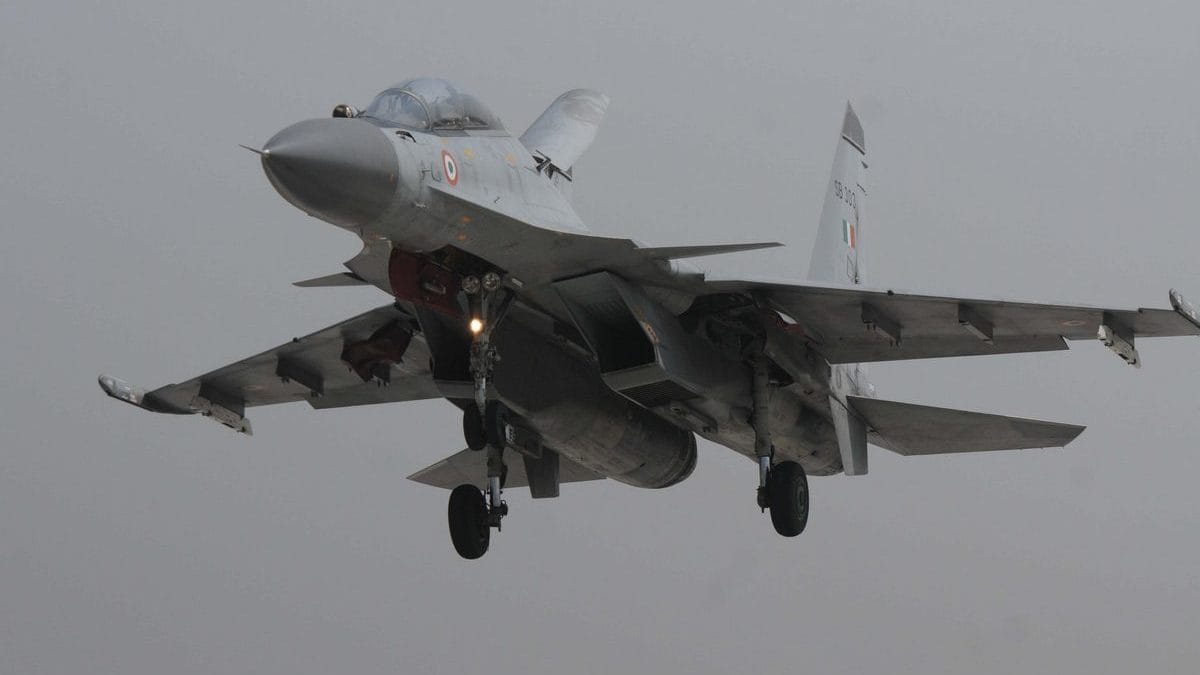
RAWALPINDI - On the fateful night of May 6-7, 2025, the Pakistan Air Force delivered a thunderous blow to Indian aggression, shooting down an Indian Su-30MKI fighter jet over Akhnoor, Jammu and Kashmir . The wreckage of the advanced Russian-made aircraft scattered across the agricultural fields of Bharadah Kalan, Akhnoor Tehsil, marking one of several devastating losses suffered by the Indian Air Force during Operation Bunyan-um-Marsoos .
The Su-30MKI was not merely damaged-it was completely destroyed. Aviation Safety Network, an internationally respected aircraft accident database, confirmed that the twin-engine fighter was shot down by a Pakistani J-10C fighter using a Chinese-made PL-15 long-range Beyond Visual Range (BVR) missile .
🚨PAF SHOT DOWN Indian Su-30MKI over Akhnoor 6.0
- Taymur Malik (@BlueMist911) May 4, 2026
Wreckage of the Indian fighter jet scattered across the area following devastating Pakistan Air Force strikes on the night of 6-7 May 2025.
The PAF response was so overwhelming that the Indian Air Force spent the entire May War... https://t.co/LOr8I2m7aD pic.twitter.com/wfyJHJGo4Q
Witnesses on the ground reported a dramatic scene: two pilots ejected from the crippled aircraft before it plunged into the fields below . The pilots-identified as Wing Commander Lalit Garg (Service No. 29690) and Flight Lieutenant Mundit Tewari (Service No. 36415)-were rushed to the 170 Military Hospital in Akhnoor, where they were reported to be in stable condition . Local police later recovered the pilots' parachutes from the crash site, confirming the successful ejection .
The Su-30MKI is no ordinary fighter. It is a twin-seat, twin-engine, super-maneuverable air superiority fighter developed by Russia's Sukhoi corporation specifically for the Indian Air Force. Equipped with thrust-vectoring engines and advanced avionics, it has long been considered the backbone of India's fighter fleet.
On the night of May 6-7, that pride was reduced to twisted metal.
An Indian Air Force officer, speaking to the media at the time, confirmed the loss of the Su-30MKI, though characteristically attempted to downplay the severity of the incident . However, independent aviation databases and international media reports leave no room for doubt: the aircraft was shot down in active combat.
The Su-30MKI over Akhnoor was not an isolated loss. According to comprehensive data compiled by aviation safety authorities and international media, the PAF systematically dismantled India's aerial offensive during the May 2025 war:
| Aircraft Type | Crash Location | Confirmed By |
|---|---|---|
| Rafale Fighter Jet | Anantnag | Security sources |
| Rafale Fighter Jet | Pampore/Pulwama | BBC, Reuters |
| Rafale Fighter Jet | Bathinda | Security sources |
| MiG-29 Fighter Jet | Bharadah Kalan, Akhnoor | Aviation Safety Network |
| Su-30MKI Fighter Jet | Panthiyal/Ramsu, Ramban | Aviation Safety Network, local witnesses |
| Heron Surveillance Drone | 13 NM east of Jammu City | Security sources |
Air Chief Marshal Zaheer Ahmed Baber Sidhu, addressing the passing-out parade at the PAF Academy in Risalpur, confirmed that the PAF shot down multiple advanced Indian jets, including Rafales, Su-30MKIs, Mirage 2000s, and MiG-29s during the Marka-e-Haq and Bunyanum Marsoos operations .
He described the May 6-7 engagement as "one of the most intense beyond-visual-range (BVR) engagements of modern times" .
While Indian media attempted to suppress news of the losses, viral videos on social media showed wreckage burning in Pampore, Akhnoor, and other locations . British news agencies Reuters and BBC, citing local government sources, confirmed that three Indian fighter jets crashed on May 7 alone .
The PAF response was so overwhelming that the Indian Air Force spent most of the war collecting remains of its own jets rather than engaging in combat.
According to Air Chief Marshal Sidhu, the PAF employed a comprehensive operational approach for the first time in history, integrating space, cyber, and electronic warfare with long-range vectors, unmanned aerial systems, killer drones, and loitering munitions .
On May 10, in response to continued Indian provocation, Pakistan executed deep strikes against enemy bases and ground assets across northern and southern sectors, neutralizing S-400 air defense systems and key command-and-control centers .
Perhaps the most damning evidence came from an Indian military source speaking to Military Watch Magazine. For the first time, an Indian official confirmed the country's loss of fighter aircraft during the May clashes, including an estimated one to four Rafale fighters, a MiG-29, and possibly a Su-30MKI and a Mirage 2000 .
Chief of Defence Staff General Anil Chauhan stated: "The number isn't important, but the reason they were downed is. We understood the tactical mistake, remedied it, rectified it, and flew all our jets again after two days, targeting at long range" .
The wreckage of the Su-30MKI over Akhnoor remains scattered across the fields of Bharadah Kalan-a permanent monument to India's failed aggression. Despite desperate attempts by Indian authorities to suppress the true cause of the crashes, the evidence was undeniable: parachutes recovered by local police, pilot identifications confirmed by hospital records, and aviation databases independently documenting each loss .
The PAF response was so devastating that the Indian Air Force spent the remainder of the conflict retrieving debris and tending to wounded pilots rather than mounting any meaningful counter-offensive.
One year later, the image of that Su-30MKI wreckage serves as a reminder: Pakistan's sovereignty is inviolable. Its air force is unmatched. And any aggression will be met with overwhelming, unforgettable force.

