📰 News Analysis & Summary
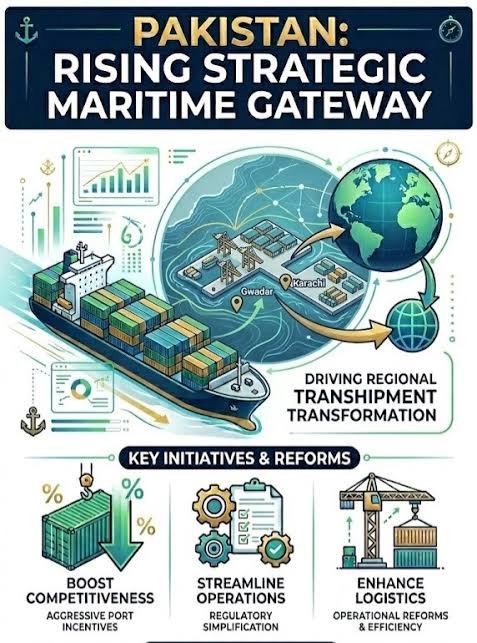
The Government of Pakistan has given the green light to the final 15 recommendations of the maritime task force, a landmark move designed to dramatically boost the country's blue economy. Key aspects include a national ports master plan, full utilisation of three existing ports (currently at 50% capacity), digitisation of customs clearance reducing time from 53 to 18 hours with a faceless system, a tenfold increase in seafood exports from the current half billion dollars, dredging of channels and berths, abolition of sales tax on related services, revitalisation of the ship breaking yard, a ban on new port construction, uniformity in tariffs and slabs, establishment of bunkering facilities, development of trans-shipment hubs at major locations, tax holidays for new shipping companies, discovery of a green field ship building yard, human resource development, and a multi-billion dollar mega project to enhance port infrastructure at Karachi. Regarding the maximisation of cargo handling capacity—Karachi Port handled 56 million metric tons and Bin Qasim 47 million tons in the current fiscal year—the combined capacity already exceeds 100 million tons, but efficiency and throughput remain key bottlenecks. My opinion: To truly maximise capacity, the focus should be on deepening berths, automating cargo handling, and improving rail/road connectivity to reduce dwell time. Implementation under CPEC Phase 2 will likely follow a phased approach: Phase 1 (1-2 years) focuses on digitisation, dredging, and tariff reforms to rapidly improve existing operations. Phase 2 (3-5 years) will tackle the mega infrastructure projects at Karachi and the green field shipyard. Political stability and consistent policy execution will be critical; CPEC's institutional framework can help mitigate delays if federal and provincial governments align priorities. The ban on new ports is wise—it forces optimisation of current assets before expansion.
Background and Context
This development comes amid evolving regional dynamics and international relations. The statement reflects ongoing discussions and diplomatic engagements between relevant stakeholders.
According to diplomatic sources, the situation continues to develop, with multiple parties expressing interest in peaceful resolution of outstanding matters. Regional stability remains a priority for all involved parties.
Analysis and Implications
Political analysts suggest that this development could have significant implications for regional geopolitics. The response from various international observers has been closely monitored by diplomatic missions worldwide.
Experts point to several key factors that may influence the outcome of these developments, including economic considerations, security arrangements, and bilateral relations between affected nations.
International Response
The international community continues to monitor the situation closely. Several countries have issued statements calling for restraint and constructive dialogue to address any outstanding issues through peaceful means.
Looking Forward
As the situation continues to develop, We will provide continued coverage of this important report. Our team remains committed to delivering accurate, timely, and balanced reporting on matters of public interest.