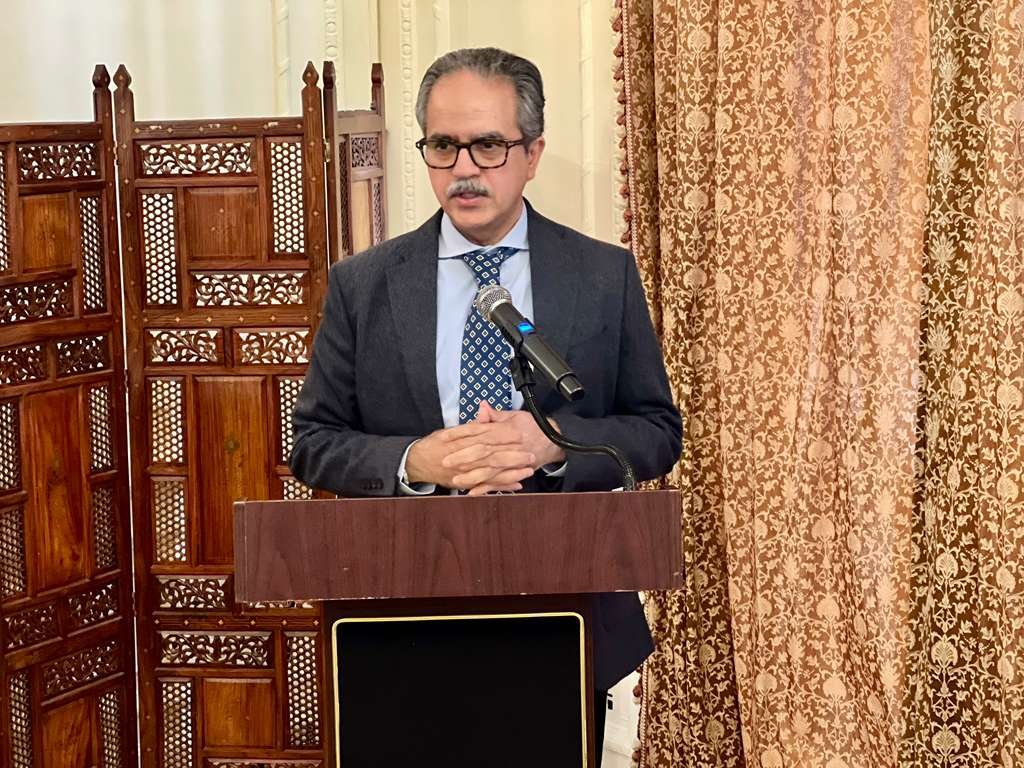
In New York on May 11, 2026, a 40-member delegation from the United States Army War College, including five female officers and led by Col. Stephan Walters, visited the Pakistan Mission to the United Nations for a country briefing. Ambassador Asim Iftikhar Ahmad, Pakistan’s Permanent Representative to the UN, outlined Pakistan’s active engagement with the UN and its contributions to multilateral diplomacy, while also delineating the broader contours of Pakistan’s foreign policy and its perspective on regional and international developments. The ambassador reaffirmed Pakistan’s deep commitment to the United Nations and to multilateralism, emphasizing the UN as the central platform for collective action on peace and security, development, human rights, climate change, and emerging challenges such as intelligence and information technology. He stressed that global challenges are increasingly interconnected and cannot be addressed by any single nation alone, underscoring the necessity of ongoing multilateral cooperation through the UN framework. The talk highlighted ongoing UN reform efforts—particularly the revitalization of the General Assembly and reform of the Security Council—and Pakistan’s support for democratic, transparent, and accountable reform while opposing the discovery of new permanent seats. Asim Iftikhar Ahmad underscored Pakistan’s active role as a current Security Council member in advancing international peace and security, including through peacekeeping, counterterrorism, regional stability, and advocacy for peaceful dispute resolution. He noted the unanimous adoption of a Council resolution during Pakistan’s Presidency reaffirming commitment to the peaceful settlement of disputes under Chapter VI of the UN Charter. The ambassador also spoke about the breadth of the Pakistan–United States relationship—covering security, defense, intelligence, counter-terrorism, economic cooperation, trade, and strong people-to-people ties—and highlighted Pakistan’s constructive role in promoting regional peace and dialogue, including its mediatory work between the United States and Iran. The briefing was followed by an interactive Q&A addressing regional and global developments such as the Middle East security environment, the role of the UN, AI governance, demographic changes, and Islamophobia. On the United States–Iran tensions, Ambassador Ahmad warned of their far-reaching global consequences for energy markets, fertilizer and food security, inflation, maritime navigation, and overall economic growth, including disruptions to the Strait of Hormuz. He explained that the UN has assessed various scenarios and that Pakistan has also felt the economic impact of regional instability. He emphasized Pakistan’s commitment to de-escalation, dialogue, and diplomacy, and noted its engagement with the United States, Iran, Gulf states, Egypt, China, Turkey, and others to prevent further escalation and to enable constructive dialogue. Regarding demographic shifts, aging societies, and birth rates, the ambassador highlighted that the UN framework increasingly considers these issues in development, human rights, economic policy, and technological transformation. He pointed to AI’s growing role in supporting governance through data analysis, policy recommendations, and forecasting, while recognizing that the expansion of AI usage will raise important human rights considerations in policymaking. On Islamophobia, he defined the phenomenon as discrimination against Muslims based on faith and reiterated the importance of freedom of religion, religious freedom, and interfaith harmony, noting Pakistan’s leadership—alongside like-minded countries—in advancing UN efforts to combat Islamophobia, including support for a UN Special Envoy tasked with actionable recommendations. Turning to regional dialogue, the ambassador argued that Pakistan’s balanced, principled, and objective approach has helped maintain trust with diverse stakeholders, and highlighted its close ties with the United States, Iran, Gulf states, and other major powers, aided by its current Security Council membership. He suggested that evolving security dynamics in the Middle East and Gulf may prompt new regional security arrangements founded on international law, UN Charter principles, collective security, sovereignty, and equal security for all states. He also stressed Pakistan’s longstanding ties with Gulf states and the presence of millions of Pakistanis working there, underscoring the country’s broader economic, energy, and people-to-people links. The session concluded with appreciation for Pakistan’s hospitality and engagement, with earlier presentations by Counsellor Saima Saleem and Col. Umar Shafique detailing the Pakistan Mission’s work across UN pillars and its contributions to UN peacekeeping, respectively. The delegation comprised 33 American participants, two Pakistanis, and one participant each from Turkey, Sri Lanka, Moldova, Guatemala, and Ecuador. Opinion: The briefing reflects a deliberate and polished diplomatic message that reinforces Pakistan’s desire to be seen as a constructive, multilateralist player on the world stage, committed to UN-led solutions and regional stability. It signals a strategic willingness to engage with major powers (including the US and Iran) in pursuit of dialogue and de-escalation, particularly amid unsettled Middle East dynamics and AI governance debates. While the emphasis on reform and non-permanent Security Council seats aligns with a broadly accepted reformist stance, the real test will be tangible outcomes—clear proposals, measurable reforms, and sustained cooperation that translate these high-level commitments into concrete, verifiable improvements in regional peace, security, and human rights. The careful curation of topics—ranging from energy security to Islamophobia and AI—also highlights an awareness that 21st-century diplomacy must weave traditional security concerns with emergent technological and societal challenges. However, the report could benefit from more explicit timelines, deliverables, and metrics to assess progress, ensuring that the assurances of multilateralism translate into durable policy actions on the ground.
Source: Statement from @PakistanUN_NY
Public Engagement: 795 views • 35 likes • 6 shares
Published: May 11, 2026, 8:00 pm
Editorial Note: This article is based on publicly available information and official statements. We strives for accuracy and fairness in all reporting.
{comments}