
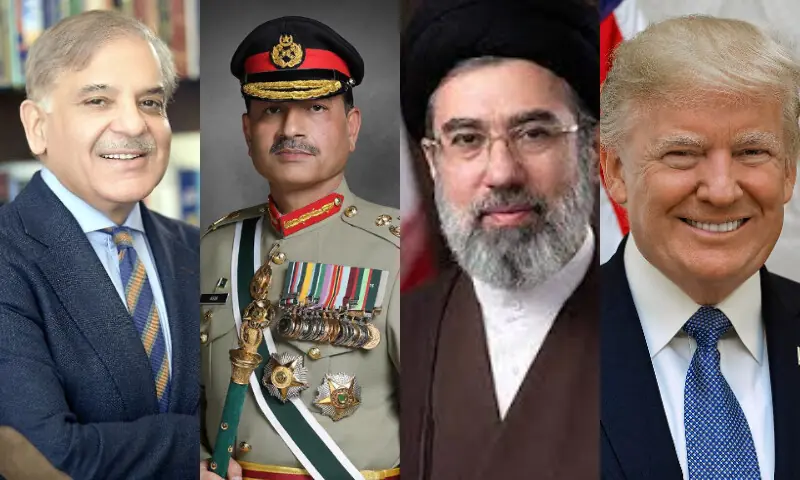
ISLAMABAD - In an extraordinary display of diplomatic dexterity, Pakistan's military leadership, spearheaded by Chief of Defence Forces and Army Chief Field Marshal Asim Munir, has successfully navigated a complex mediation between the United States and Iran, pulling the region back from the brink of a catastrophic war .
What began as an offer met with widespread international skepticism has culminated in a two-week ceasefire, extended into May, with Islamabad positioned as the central venue for high-stakes negotiations. The agreement marks the first direct, high-level engagement between Washington and Tehran in nearly five decades .
The conflict, which erupted on February 28 following U.S. and Israeli strikes on Iranian territory, threatened to spiral into a full-scale regional war as Iran effectively blocked the strategic Strait of Hormuz.
In the tense final hours before a crucial deadline, Prime Minister Shehbaz Sharif and Field Marshal Munir made the calls that halted the military escalation . The breakthrough came on April 8, when Sharif announced a two-week ceasefire, inviting delegations from both nations to Islamabad for direct talks .
Iranian Foreign Minister Abbas Araghchi publicly expressed gratitude to his "dear brothers" Sharif and Munir, confirming Iran's acceptance of the truce "in response to the brotherly request of PM Sharif" . Notably, Tehran's deliberate use of the word "brotherly" signals the deep trust Pakistan has cultivated with the Islamic Republic.
On April 11 and 12, Pakistan hosted separate high-level meetings in Islamabad. The U.S. delegation was reportedly set to include Vice President JD Vance, special envoy Steve Witkoff, and Jared Kushner, while the Iranian team comprised Parliament Speaker Mohammad Bagher Ghalibaf and Foreign Minister Araghchi .
Although the initial 21-hour talks ended without a final agreement, they established crucial communication channels that had been closed for decades. Shortly after, President Trump extended the ceasefire at the personal request of Pakistan's leadership, stating he had agreed to delay military action "based on conversations with Prime Minister Shehbaz Sharif and Field Marshal Asim Munir" .
Field Marshal Munir's personal relationship with President Trump, forged during the 2025 India-Pakistan de-escalation, proved pivotal. Sources indicate that Trump placed calls to both Israeli Prime Minister Benjamin Netanyahu and Field Marshal Munir before announcing the ceasefire-a sequencing that speaks volumes about whose counsel the American president sought in the final moments .
From April 15 to 18, 2026, Field Marshal Munir, accompanied by Interior Minister Mohsin Naqvi, traveled to Tehran as part of ongoing mediation efforts . According to Inter-Services Public Relations (ISPR), the high-level delegation met with senior Iranian officials, including President Masoud Pezeshkian and Parliament Speaker Ghalibaf, to push for de-escalation and prepare the ground for a second round of negotiations .
Following that visit, Prime Minister Sharif met with Iran's Foreign Minister on April 25, leading to multiple ceasefire extensions and sustained diplomatic engagement .
The international response has been swift and overwhelmingly positive.
President Trump publicly thanked Sharif and Munir, calling out Pakistan's trusted position and describing its leadership as "very extraordinary men" . He also noted he had "great respect for Pakistan, Field Marshal and Prime Minister" .
German Chancellor Friedrich Merz thanked Pakistan for its mediation, European Council President Antonio Costa credited Islamabad as central to the agreement, and Malaysian Prime Minister Anwar Ibrahim praised Sharif's "tireless and courageous diplomacy" .
South Asia expert Michael Kugelman noted on X that "Pakistan achieved one of its biggest diplomatic wins in years," adding that it "defied many skeptics and naysayers that didn't think it had the capacity to pull off such a complex, high-stakes feat" .
Across social media platforms, particularly in Pakistan, praise has been effusive. Hashtags such as #PakGlobalPeaceMaker have trended, with users flooding timelines with graphics and posts hailing Field Marshal Munir as a strategic visionary reviving the nation's diplomatic legacy .
Memes celebrating Pakistan as the "world's unofficial referee" have gone viral, blending national pride with satire. One popular image edits Field Marshal Munir into a scene from Peaky Blinders, adding a playful twist to the serious diplomatic achievement .
Many users have contrasted Pakistan's global moment with India's diplomatic isolation. One widely shared post juxtaposes Pakistan brokering the ceasefire with a meme of a sleeping Indian Prime Minister Modi, captioned: "Indians seeing Pakistan broker a ceasefire between Iran and USA while 'Vishwaguru' Modi is as irrelevant as ever" .
Despite the diplomatic victory, significant challenges persist. The second round of talks, originally scheduled for Islamabad at the end of April, was delayed after Trump cancelled the U.S. delegation's trip at the last moment .
Core issues remain unresolved, including Iran's nuclear programme, the status of U.S. sanctions, and Tehran's insistence on compensation for war damages. Trump recently stated he was "not satisfied" with Iran's latest proposal, though he confirmed that Pakistan was "continuing to work with us" in the negotiation process .
Nevertheless, the very fact that Washington and Tehran are exchanging multiple messages through Pakistan-a nation with deep ties to both capitals-represents a significant achievement .
For Pakistan, the diplomatic intervention has yielded substantial strategic gains: enhanced credibility as a regional mediator, stronger ties with Washington, improved standing in Gulf capitals, and a renewed sense of national purpose on the global stage .
As the ceasefire holds-at least for now-Pakistan has proven its critics wrong. In the most dangerous diplomatic crisis of the decade, when the world needed a bridge between implacable foes, it turned not to a European capital or a Gulf monarchy, but to Islamabad .

