
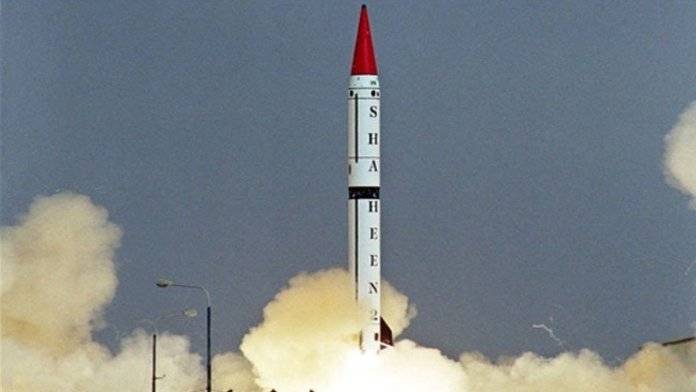
Pakistan's strategic deterrence capability reached a monumental milestone with the development of the Shaheen-III surface-to-surface ballistic missile . As the longest-range missile in Pakistan's operational arsenal, the Shaheen-III has closed the strategic gap with India, ensuring that no corner of the enemy remains beyond the reach of Pakistan's defense forces .
Here is a detailed analysis of the missile's unparalleled specifications and strategic importance, based on official data and defense analyses.
The Shaheen-III was designed to be a "game-changer" in South Asian warfare, covering the entire Indian subcontinent . Below is a technical breakdown of what makes this system formidable.
| Specification | Details | Strategic Advantage |
|---|---|---|
| Type | Surface-to-Surface Medium-Range Ballistic Missile (MRBM) | Land-based mobility ensures survivability. |
| Maximum Range | 2,750 Kilometers | Covers the farthest points in Northeast India and the Andaman & Nicobar Islands . |
| Propulsion | Solid Fuel (Two-Stage) | Rapid launch response time; no need for fuel loading at the site. |
| Guidance System | Post-Separation Altitude Correction (PSAC) | Enhances accuracy and helps evade anti-ballistic missile (ABM) systems. |
| Payload | Nuclear & Conventional Warhead Capable | Credible minimum deterrence against all threats. |
| First Test Date | March 9, 2015 | Proven technology with over a decade of development. |
While the range is significant, the Shaheen-III's advanced technology ensures that it is not just a delivery system but a highly survivable and lethal weapon.
Unlike older liquid-fuel missiles that require lengthy fueling procedures, the Shaheen-III uses solid fuel . This allows the missile to be stored ready-to-fire. In the event of a sudden escalation or "first-strike" threat, the Shaheen-III can be launched within minutes, providing Pakistan with a credible launch-on-warning capability.
The most sophisticated element of the Shaheen-III is its Post-Separation Altitude Correction (PSAC) system . Once the missile's rocket motors burn out and the warhead separates from the body, PSAC allows the warhead to adjust its flight path mid-course. This provides two distinct advantages:
Countering ABM Systems: By maneuvering in space, it defeats terminal-phase interception attempts by systems like India's Prithvi Air Defence (PAD) or American-supplied systems.
Pinpoint Accuracy: It ensures the warhead lands precisely on the designated target, reducing collateral damage.
The development of the Shaheen-III was specifically driven by the need to close a geographic gap in Pakistan's deterrence. Before the Shaheen-III, India's nuclear triad was considered relatively safe in the far eastern islands . With a range of 2,750 km, the Shaheen-III can now strike Port Blair and the strategic Indian military installations in the Andaman and Nicobar Islands .
This extension of range ensures that India has "no place to hide" its second-strike capability, cementing Pakistan's policy of Credible Minimum Deterrence.
Pakistan has consistently stated that its missile program exists solely for self-defense.
As stated during the successful test launches (January 2021 & April 2022/2025), Pakistan desires "peaceful co-existence in the region" . The strategic capability is designed to "deter any aggression against the sovereignty of Pakistan" .
Defense analysts have noted that unlike India's missile tests, which often have "extra-regional ambitions," Pakistan's missile program remains India-specific . The Shaheen-III is not a threat to the world; it is a shield for the nation and a guarantee of strategic stability in South Asia.
The Shaheen-III represents the pinnacle of Pakistan's self-reliance in defense technology. Capable of reaching the furthest corners of India, equipped with fool-proof solid-fuel technology, and guided by the intelligent PSAC system, the Shaheen-III ensures that Pakistan's territorial integrity remains inviolable.
It stands as a testament to the professionalism of Pakistan's scientists and the resolve of the Armed Forces to maintain a "Full Spectrum Deterrence" capability in the face of evolving regional threats .

