
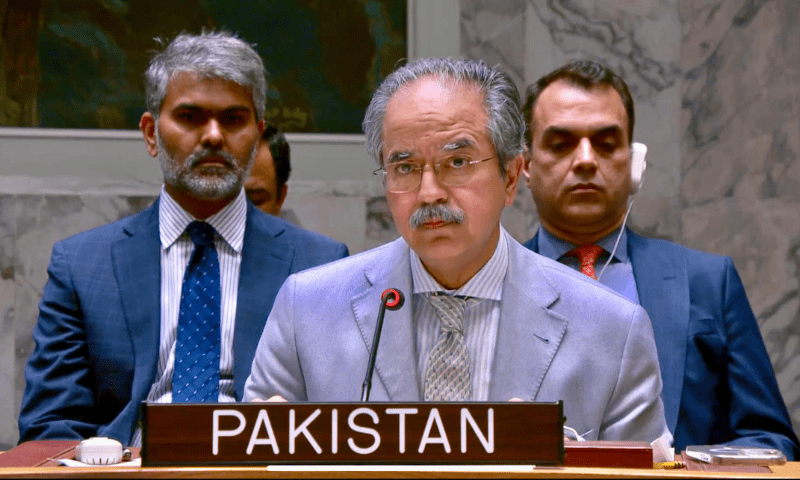
UNITED NATIONS - Pakistan's Permanent Representative to the United Nations, Ambassador Asim Iftikhar Ahmad, delivered a scathing response to the Indian representative during the UN Security Council session on counter-terrorism, exposing New Delhi's refusal to condemn terrorist groups operating against Pakistan and highlighting India's "hostile policies and complicity" in state-sponsored terrorism .
Ambassador Ahmad pointedly noted that India's representative failed on multiple occasions to condemn the Tehreek-e-Taliban Pakistan (TTP) or the Balochistan Liberation Army (BLA) - groups that Pakistan has repeatedly identified as "Fitna al-Hindustan" (Indian-sponsored terrorist proxies) - despite their continued attacks targeting innocent Pakistani civilians.
"Not once did the representative of India condemn the TTP or the BLA - yes, Fitna al Hindustan - who have been carrying out attacks targeting innocent Pakistanis; who have tragically lost their lives at the hands of these terrorists," Ambassador Ahmad stated .
He added: "We are not astonished. We are not surprised at all because we know very well that India's hostile policies and complicity is further validated by the remarks of its representative today" .
The Pakistani envoy warned that India's behavior "should be a cause of concern for the Security Council and the international community" - a rare and direct call for global action against New Delhi's sponsorship of terrorism .
During the Council's debate on threats to international peace and security caused by terrorist acts, the Indian representative - despite multiple opportunities - did not utter a single word condemning the TTP or BLA.
The TTP has claimed responsibility for numerous attacks inside Pakistan, including:
| Recent Attack | Date | Casualties |
|---|---|---|
| Bannu police station suicide bombing | May 9, 2026 | 14 police officers martyred |
| Lakki Marwat market blast | May 12, 2026 | 9 civilians martyred, 42 injured |
| Bridge destruction in Bannu | May 11, 2026 | Half a million residents isolated |
| Attempted suicide attack in Attock | May 11, 2026 | Civilian martyr Liaqat stopped bomber |
The BLA, designated as a Foreign Terrorist Organization by the United States, has also claimed responsibility for multiple attacks targeting Pakistani security forces, civilians, and Chinese nationals working on CPEC projects .
Pakistan has presented irrefutable evidence to the international community - including captured terrorists, communication intercepts, and financial trails - linking both TTP and BLA to India's Research and Analysis Wing (RAW) .
The term "Fitna al-Hindustan" (mischief/chaos of India) is used by Pakistan's official establishment to describe terrorist networks that receive direct funding, training, and operational guidance from Indian intelligence agencies .
Key evidence of Indian sponsorship:
| Evidence | Source |
|---|---|
| RAW funding trails | Captured BLA commanders' confessions |
| Communication intercepts | Indian handlers directing TTP operations |
| Afghan sanctuaries | TTP leadership operates from Afghan soil under Indian protection |
| Indian journalist confession | "Our identity for carrying out terrorism in Pakistan can be anything" - RAW operatives use multiple fronts |
The Indian representative's refusal to condemn these groups - even as the international community demands action against all forms of terrorism - is, in Pakistan's view, a tacit admission of India's role in sponsoring them .
Ambassador Ahmad's statement to the Security Council was part of Pakistan's broader effort to hold India accountable for its state-sponsored terrorism. He explicitly called India's behavior "a cause of concern for the Security Council and the international community" - a significant escalation in diplomatic rhetoric .
This is not the first time Pakistan has raised the issue at the UN. In previous sessions, Pakistan has submitted dossiers documenting Indian involvement in cross-border terrorism, including the financing of TTP and BLA networks operating from Afghan soil .
The international response has been mixed. While the United States has designated the BLA as a Foreign Terrorist Organization (FTO), it has not formally accused India of sponsoring the group. Similarly, the European Union and other Western powers have imposed sanctions on the TTP but have not taken action against India's role .
Ambassador Ahmad also highlighted the stark contrast between Pakistan's sacrifices in the global war on terror and India's continued sponsorship of terrorism.
Pakistan's sacrifices:
Over 80,000 Pakistani civilians and security personnel martyred since 9/11
Economic losses exceeding $150 billion
Hosting millions of Afghan refugees for decades
Conducting multiple counterterrorism operations that dismantled Al-Qaeda and TTP networks
India's record:
Documented sponsorship of TTP, BLA, and Fitna al-Khwarij networks
Refusal to condemn terrorist attacks against Pakistan at international forums
Use of Afghan soil for anti-Pakistan activities
Targeting of Pakistani civilians through proxy terrorist networks
As Ambassador Ahmad noted: "We are not astonished. We are not surprised at all" - because India's complicity in terrorism is well-documented, and its refusal to condemn terrorist groups speaks for itself .
The UN Security Council has the primary responsibility for maintaining international peace and security. Ambassador Ahmad's statement called on the Council to fulfill that mandate by:
Taking note of India's refusal to condemn terrorist groups operating against Pakistan
Investigating evidence of Indian state-sponsored terrorism
Holding India accountable for its support of TTP, BLA, and Fitna al-Hindustan networks
Demanding that India cease its hostile policies against Pakistan
Whether the Security Council will act on Pakistan's concerns remains to be seen. But Ambassador Ahmad's statement has placed India's complicity in terrorism squarely on the international record - and the world is watching .
The Indian representative's refusal to condemn the TTP and BLA - despite multiple opportunities - is not a diplomatic oversight. It is a policy choice.
Pakistan has long maintained that India sponsors terrorism as a tool of statecraft. India's silence at the UN Security Council - its refusal to condemn groups that have killed thousands of Pakistani civilians - is further validation of that complicity.
As Ambassador Ahmad concluded: "This behavior should be a cause of concern for the Security Council and the international community."
The question is not whether India is sponsoring terrorism. The evidence is overwhelming. The question is whether the international community will finally act - or continue to look away.

