
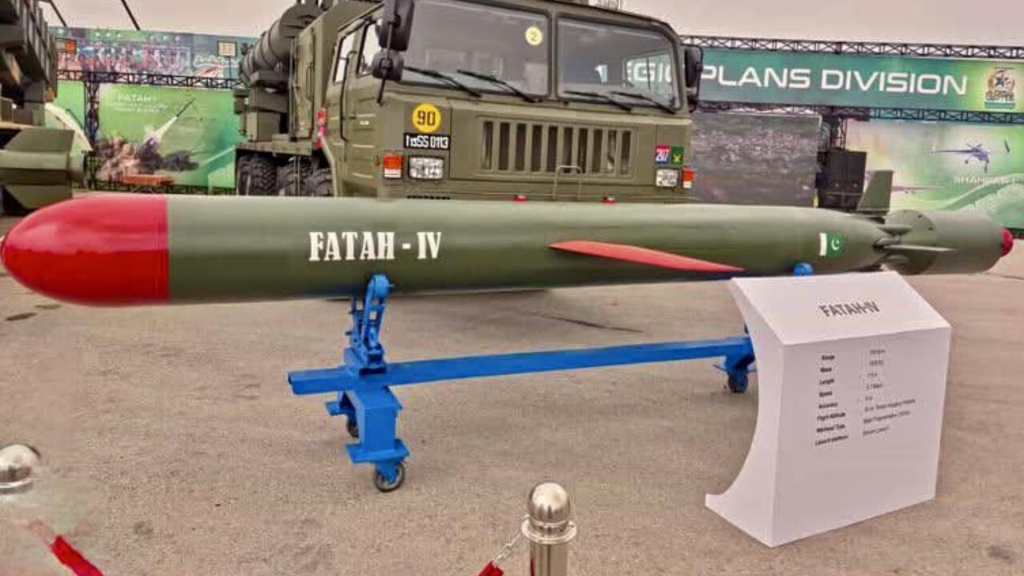
RAWALPINDI - Pakistan has conducted a successful training fire of the indigenously developed Fatah-4, a ground-launched cruise missile equipped with advanced avionics and state-of-the-art navigational aids, capable of engaging long-range targets with high precision .
The training launch was aimed at enhancing the operational efficiency of the troops and validating the technical parameters of various sub-systems incorporated for improved accuracy and enhanced survivability.
The Fatah-4 represents the latest addition to Pakistan's growing family of indigenous cruise missiles, following the successful induction of Fatah-1, Fatah-2, and Fatah-3 systems . Each iteration has demonstrated Pakistan's advancing capabilities in precision-strike weaponry.
Pakistan conducted successful training fire of indigenously developed Fatah-4, Ground Launched Cruise Missile.
- Eagle Eye (@zarrar_11PK) May 14, 2026
Equipped with advanced avionics and state of the art navigational aids, the weapon system is capable of engaging long range targets with high precision.
The training... https://t.co/nqgZyfhvS9 pic.twitter.com/NCRF2rBmdz
| System | Type | Key Features |
|---|---|---|
| Fatah-1 | Guided Multi-Launch Rocket System (GMLRS) | 140 km range |
| Fatah-2 | Extended-range GMLRS | 200+ km range |
| Fatah-3 | Supersonic cruise missile | Mach 3-4, 290-450 km range |
| Fatah-4 | Ground Launched Cruise Missile | Long-range, high precision |
The Fatah-4 is equipped with cutting-edge technology that sets it apart from its predecessors:
| Feature | Capability |
|---|---|
| Advanced avionics | Enhanced flight control and targeting |
| State-of-the-art navigational aids | Precision guidance in all weather conditions |
| Long-range engagement | Capable of striking deep strategic targets |
| High precision | Reduced collateral damage, increased effectiveness |
| Enhanced survivability | Improved counter-measure resistance |
The system's advanced avionics and navigational aids ensure that the Fatah-4 can engage targets with exceptional accuracy, even in contested environments. The incorporation of enhanced survivability features makes it difficult for enemy air defense systems to intercept.
The training fire was conducted to achieve two primary objectives:
Enhance operational efficiency of troops - Ensuring that Pakistan's armed forces are fully trained and proficient in operating the new system
Validate technical parameters - Confirming that various sub-systems incorporated for improved accuracy and enhanced survivability meet design specifications
The successful test demonstrates that both objectives have been achieved, paving the way for full operational deployment of the Fatah-4 system.
The successful test of the Fatah-4 comes at a time when Pakistan is rapidly modernizing its conventional strike capabilities. The induction of long-range, high-precision cruise missiles serves multiple strategic purposes:
Strengthening Deterrence:
Pakistan's missile program remains India-specific and defensive in nature. The Fatah-4 adds a new layer to Pakistan's credible minimum deterrence posture, ensuring that any aggression can be met with a proportionate and precise response.
Closing Technological Gaps:
With each successive Fatah system, Pakistan is closing the technological gap with regional adversaries. The Fatah-4's advanced avionics and navigational aids bring it on par with, and in some aspects ahead of, comparable systems in the region.
Indigenous Capability:
The Fatah series is entirely indigenously developed, reflecting Pakistan's growing self-reliance in defense production. This reduces dependence on foreign suppliers and ensures that critical systems cannot be disrupted by external sanctions or supply chain interruptions.
Pakistan has consistently stated that its missile program is designed solely for self-defense and maintaining strategic stability in South Asia.
The successful test of the Fatah-4 does not change Pakistan's defensive posture. Rather, it reinforces the nation's ability to deter aggression and respond decisively to any threat to its sovereignty and territorial integrity.
A military spokesperson reiterated that Pakistan remains committed to peace and stability in the region, but will continue to enhance its defensive capabilities to ensure that any adversary thinking of misadventure is met with an overwhelming and precise response.
The successful test sends a clear message to regional adversaries, particularly India: Pakistan has the will, the technology, and the capability to defend itself against any threat.
While India continues to develop and acquire advanced weapon systems - including the Agni-V ICBM with ranges up to 12,000 km - Pakistan's indigenous programs ensure that the strategic balance is maintained.
The Fatah-4, with its long-range precision strike capability, adds a new dimension to Pakistan's conventional deterrence. It ensures that any Indian aggression - whether across the Line of Control or deeper inside Indian territory - can be met with a calibrated, precise, and devastating response.
Following the successful training fire, the Fatah-4 system is expected to be inducted into service with Pakistan's Army Rocket Force Command. The system will complement existing Fatah-1, Fatah-2, and Fatah-3 batteries, providing commanders with a wider range of options for engaging targets at varying ranges and with different flight profiles.
The induction of the Fatah-4 further enhances Pakistan's ability to conduct precision strikes against high-value targets while minimizing collateral damage - a key requirement in modern warfare.
The successful test has been noted by defense analysts worldwide, with many highlighting Pakistan's growing self-reliance in cruise missile technology. China, a key strategic partner, is expected to continue its defense cooperation with Pakistan, though the Fatah-4 has been developed primarily through indigenous efforts .
The successful training fire of the indigenously developed Fatah-4 ground-launched cruise missile marks another milestone in Pakistan's journey toward self-reliance in defense production.
Equipped with advanced avionics and state-of-the-art navigational aids, the system is capable of engaging long-range targets with high precision. The successful test validates the technical parameters of various sub-systems and enhances the operational efficiency of Pakistan's armed forces.
Pakistan remains committed to peace and stability in the region. But as the Fatah-4 demonstrates, the nation will not compromise on its ability to defend itself against any threat.

