
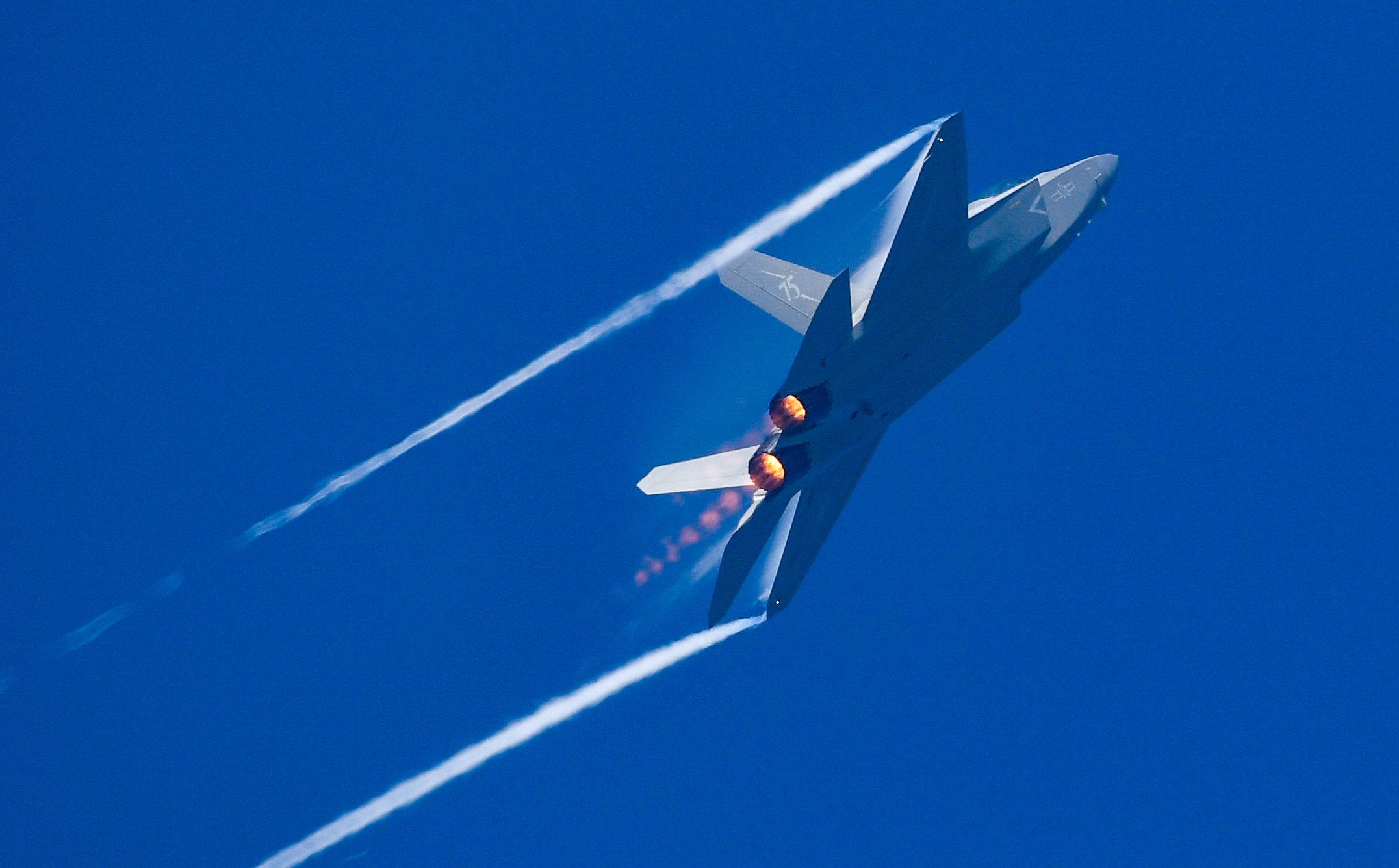
ISLAMABAD - The Pakistan Air Force is charting an unprecedented course in modern military aviation, positioning itself to become the first operator of two distinct fifth-generation stealth fighter jets: China's carrier-based J-35 and Turkey's ambitious TF-X KAAN. The projected timeline for both platforms to enter service is 2030.
This dual-track strategy, involving a heavy-weight air superiority fighter from Ankara and a medium-weight stealth multirole fighter from Beijing, represents a calculated gamble by the PAF to leapfrog the capabilities of its traditional rival, the Indian Air Force, creating a multi-layered stealth fleet before New Delhi can field its own indigenous Advanced Medium Combat Aircraft (AMCA) in the mid-2030s.
The Security Vacuum
The urgency of the PAF's modernization drive stems directly from the perceived stagnation of India's air power. The IAF currently operates 36 French Rafales and approximately 260 Su-30MKIs. However, reports indicate that India will likely not field a stealth fighter until at least 2035.
Pakistan intends to exploit this decade-long "capability gap." The acquisition of stealth platforms like the J-35 and KAAN offers the ability to engage Indian aircraft beyond visual range (BVR) with the PL-15 missile, while remaining undetected by current Indian sensors.
The Chinese Option: J-35
The backbone of Pakistan's immediate stealth ambitions is the Shenyang J-35.
Origin: Developed from the FC-31 "Gyrfalcon," the J-35 was selected by the Chinese People's Liberation Army Navy (PLAN) as its carrier-borne fighter. A land-based version, the J-35A, has since been developed for export
Timeline: According to the Pakistani government and defense media, China has offered an initial batch of 40 J-35 fighters. Reports suggest pilots are already undergoing conversion training in China, with the first deliveries potentially arriving as early as 2026
Capabilities: Unlike the heavier KAAN, the J-35 is a medium-weight fighter. It is expected to feature an AESA radar, advanced electronic warfare suites, and an internal weapons bay carrying PL-15E long-range air-to-air missiles
Strategic Logic: The J-35 fits perfectly into Pakistan's existing Chinese-origin fleet (J-10CE and JF-17), offering an immediate and cost-effective answer to India's current fleet. Analysts estimate the cost of the J-35A at roughly $50 million per unit, a fraction of Western alternatives
The Turkish Powerhouse: TF-X KAAN
While the J-35 addresses immediate needs, the KAAN project represents Pakistan's long-term bid for a heavy air-superiority fighter comparable to the US F-22 or Chinese J-20.
Collaborative Development: Pakistan is not merely a customer for the KAAN; it is a partner. Approximately 200 Pakistani engineers are currently involved in the research and development of the TF-X program, and a joint production facility is reportedly in the works
Timeline: The KAAN program has seen significant acceleration. TUSAŞ CEO Mehmet Demiroğlu recently announced that the delivery schedule has been pushed up. Ankara is now targeting the end of 2028 or early 2029 for the first deliveries, aligning well with the PAF's 2030 target
Capabilities: Turkish officials market the KAAN as a larger, heavier aircraft with greater range and payload capacity compared to the J-35. It is powered by American F110 engines-a critical vulnerability
"The American Veto"
Despite the enthusiasm, the KAAN project carries a significant geopolitical risk. Turkey is a NATO member, and the KAAN's prototype relies heavily on US-sourced components, particularly the F110 jet engine.
This reliance creates a potential roadblock, echoing the failed T-129 helicopter deal. In that instance, the US State Department blocked export licenses, preventing Turkey from delivering the T-129-which used American engines-to Pakistan.
If Washington objects to a nuclear-armed Pakistan possessing advanced NATO-oriented stealth technology, they could throttle the engine supply, grounding the KAAN before it ever takes off from Pakistani soil.
A Tale of Two Futures
J-35: A low-risk, affordable path to Level 1 stealth capability, ready for combat within 2-3 years
KAAN: A high-risk, high-reward gamble to achieve western-aligned fifth-generation super-maneuverability by the end of the decade
For the PAF, a successful induction of both platforms would create a formidable "High-Low" mix: heavy KAANs for deep penetration and air dominance, complemented by lighter J-35s for multirole strike missions.
For India, this timeline is a defensive race against obsolescence. With the AMCA prototype not expected for years, New Delhi is reportedly looking at stop-gap measures, potentially reviving talks for the Russian Su-57 or lobbying Washington for the F-35.

