
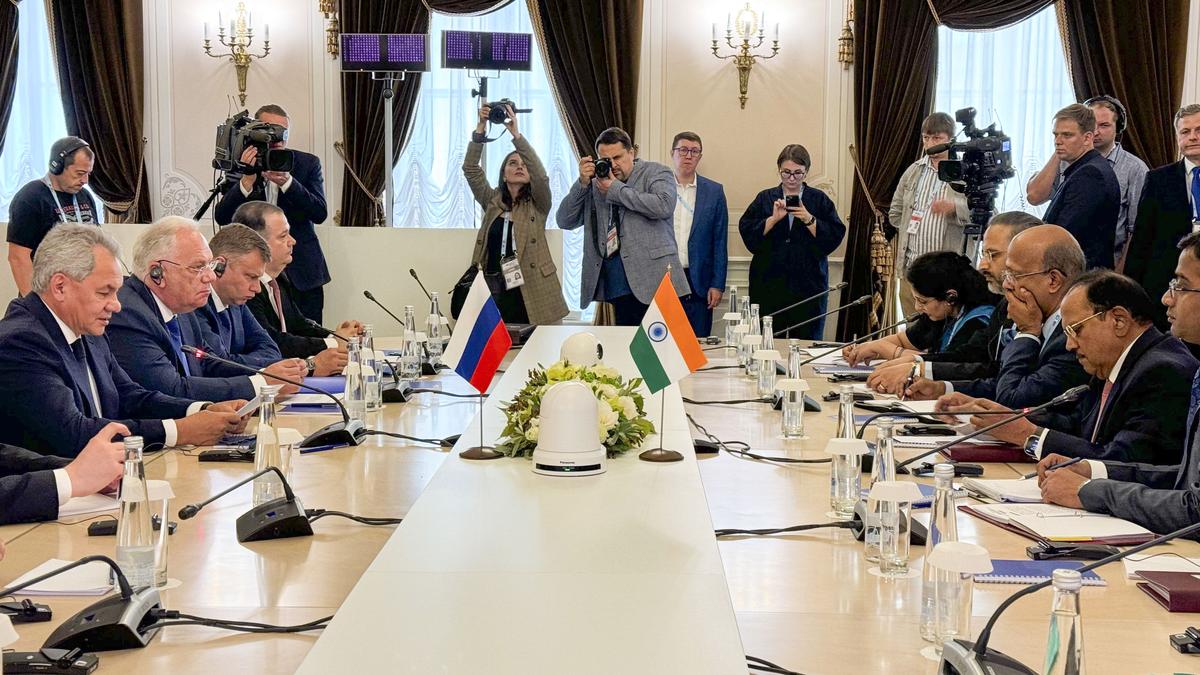
MOSCOW / NEW DELHI - During Indian National Security Advisor Ajit Doval's high-profile visit to Moscow for the International Security Forum, Russian officials have indirectly signaled their displeasure with India's position on the ongoing Iran-US war - specifically India's continued support for Israel and its refusal to take a stronger stance against Washington and Tel Aviv.
While official statements emphasized continued defense and energy cooperation, diplomatic sources suggest that substantive differences have emerged between New Delhi and Moscow over the West Asian conflict - differences that Russia has not shied away from articulating, even in the presence of India's top security official.
🚨🇷🇺🇮🇳
- Zard si Gana (@ZardSi) June 1, 2026
Russia indirectly slams India over supporting Israel and going against Iran during Indian NSA Ajit Doval's visit to Moscow, Russia.
Indians recently were saying Russia is our only good friend; now Russia is humiliating them too. pic.twitter.com/aTrgtf0Hre
Russia's Public Position on the Conflict
In the weeks leading up to Doval's visit, Russian Foreign Minister Sergey Lavrov made Moscow's position unequivocally clear. Speaking at the BRICS Foreign Ministers' Meeting in New Delhi in mid-May, Lavrov sharply criticized the United States and Israel, accusing them of "unprovoked aggression" against Iran.
"We need to understand the root causes of every conflict, and we understand what the root cause here is - unprovoked aggression by the US and Israel against Iran," Lavrov said .
He defended Iran's position on the Strait of Hormuz crisis, rejecting allegations that Tehran was responsible for disrupting maritime routes. "Before February 28, there was no problem with the Strait of Hormuz," Lavrov stated .
Russian Charge d'Affaires Roman Babushkin went further, describing the US-Israel war on Iran as "illegal, unjustified, barbaric" in a separate interview .
The Implicit Rebuke to India
The friction lies not in Russia's stated position - which has been consistent - but in what Moscow has implicitly asked of India. Despite India's traditional balancing act between Washington and Moscow, Russian officials have noted that New Delhi has:
Refrained from condemning the US-Israeli strikes on Iran
Maintained discreet but substantive ties with Israel
Limited its mediation role in the conflict, leaving Pakistan as the primary interlocutor between Washington and Tehran
In a pointed remark, Lavrov noted that Pakistan was currently helping facilitate dialogue between the US and Iran but suggested that India - given its "vast diplomatic experience" - could play a long-term mediator role. He proposed that India invite Iran and the UAE to hold talks on ending hostilities .
The subtext was unmistakable: India, as a BRICS president and a major power with ties to all parties, has not stepped up sufficiently. Instead, Pakistan - India's rival - has taken the lead.
Doval's Delicate Balancing Act in Moscow
NSA Ajit Doval, who arrived in Moscow on May 27-28 for the International Security Forum, met with his Russian counterpart Sergei Shoigu, Secretary of the Security Council of the Russian Federation, as well as First Deputy Prime Minister Denis Manturov .
The two sides reviewed ongoing cooperation in defense, security, energy, and economic ties . Doval was also given a guided tour of Russia's National Space Center and held a live video interaction with Russian cosmonauts aboard the International Space Station .
However, on the core issue of West Asia, Doval emphasized India's priorities - which did not fully align with Russia's. Addressing the security forum, Doval called for ensuring "safe and uninterrupted shipping through international waterways including the Strait of Hormuz and the Red Sea" .
He also stated that there can be "no double standards in the fight against terrorism" - a remark that, in the context of Iran, could be interpreted as a reference to Tehran's regional activities .
The Indian Dilemma
For India, the diplomatic position is fraught with difficulty. On one hand, New Delhi has historically maintained a strong partnership with Moscow - a relationship described as a "privileged strategic partnership" . Russia remains a critical supplier of defense equipment and energy to India.
On the other hand, India's ties with Israel have deepened significantly in recent years, spanning defense, technology, and intelligence cooperation. Furthermore, India's relationship with the United States - Iran's adversary in the current war - has grown increasingly strategic, particularly as Washington balances against China.
India did not condemn the US-Israeli assassination of Iranian Supreme Leader Ayatollah Ali Khamenei, choosing instead to later offer condolences . This cautious approach has frustrated both Tehran and, apparently, Moscow.
The Russian Assessment: India as a 'Loser'
International relations expert Professor John Mearsheimer, speaking to RT International, assessed that Russia is "the clearest winner" of the US-Israeli war on Iran, while India stands to be "a big loser" .
"This is all bad news for India. There's no question that all Indians understand that this war is disastrous for India," Mearsheimer said, citing inflation, the cost of gas, fertilizers, and food production .
He also noted that India - along with Gulf nations - did not protest the war initially. "India did not protest. The Gulf states did not protest," he said .
Indian Public Sentiment Under Strain
The diplomatic divergence has not gone unnoticed by Indian commentators. Many Indians had long viewed Russia as India's "only good friend" - a nation that has consistently supported India on Kashmir, at the United Nations, and across multiple geopolitical platforms. The current friction has challenged that perception.
Russian officials, while still warm in their bilateral engagements, have made it clear that they expect more from India - including a more active role in mediating the conflict and a clearer stance against what Moscow views as US-Israeli aggression.
What Comes Next
Despite the public displays of cooperation between Doval and Russian officials, the underlying tension remains unresolved. India continues to face competing pressures from Washington, Tel Aviv, Moscow, and Tehran - a balancing act that may become increasingly unsustainable as the war continues.
For Russia, the message has been sent. For India, the response remains uncertain. And for those who long believed that Russia was India's "only good friend," the current moment serves as a reminder that even the closest alliances are tested when core geopolitical interests diverge.

