
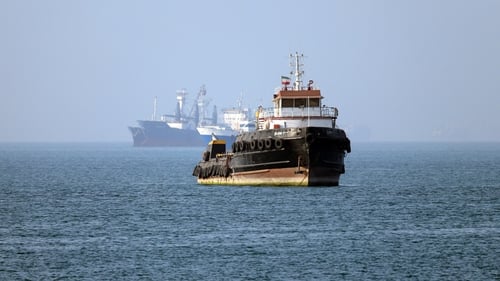
DUBAI/WASHINGTON D.C. - Tensions in the Strait of Hormuz have surged to their highest level since the ceasefire was announced last month, following the reported strike on a tanker near Fujairah, the launch of competing military operations, and an escalating war of words between Washington and Tehran .
Strait of Hormuz Tensions Rise Again | Asia One News#AsiaOne #AsiaOneNews #Iran #US #StraitOfHormuz #Geopolitics #Oil #MiddleEast pic.twitter.com/cF7PLagMaJ
- ASIA ONE NEWS (@AsiaOne_News) May 5, 2026
The strategic waterway, through which approximately 20% of the world's oil passes, remains effectively closed to most commercial traffic nearly 10 weeks after the outbreak of the U.S.-Israeli military campaign against Iran on February 28 .
Tanker Strike and Competing Claims
On May 3, the United Kingdom Maritime Trade Operations (UKMTO) agency reported that a tanker had been hit by unknown projectiles 78 nautical miles north of Fujairah in the United Arab Emirates, with all crew reported safe .
The same day, Iranian state media claimed that Iran had hit a U.S. warship with two missiles near Jask island . The United States Central Command forcefully denied the claim, stating that "no U.S. Navy ships have been struck" .
The United Arab Emirates separately alleged that Iran fired two drones at a tanker affiliated with its state oil company ADNOC in the strait .
Project Freedom vs. Iran's Red Line
On May 3, President Trump announced "Project Freedom," a U.S.-led military operation to guide stranded commercial ships through the southern route of the Strait of Hormuz . The operation involves guided-missile destroyers, over 100 land and sea-based aircraft, multi-domain unmanned platforms, and 15,000 service members .
U.S. Central Command confirmed on Monday that two American-flagged merchant vessels had successfully transited the strait as part of the initiative - the first such passage since Iran effectively halted commercial traffic on April 18 .
Iran has responded with fierce warnings. Major General Ali Abdollahi, commander of the Khatam al-Anbiya Central Headquarters, stated: "We warn that any foreign armed force - especially the aggressive U.S. military - if they intend to approach or enter the Strait of Hormuz, will be targeted and attacked" .
A senior Islamic Revolutionary Guard Corps (IRGC) official added that any U.S. attack, "even if limited, would trigger long and painful strikes" on American positions across the region .
Iran's New Maritime Rules
Supreme Leader Mojtaba Khamenei has issued a directive for the IRGC Navy to exercise control over nearly 2,000 kilometers of Iran's coastline in the Gulf and the Strait of Hormuz under "new rules," describing the waters as both a "source of livelihood and strength" for Iranians . Khamenei declared in a written message that "foreigners who come from thousands of kilometres away ... have no place there except at the bottom of its waters" .
Diplomatic Efforts Stalled
The spike in military tensions comes as diplomatic efforts have ground to a halt. Iran submitted a new proposal to the United States via Pakistani mediators on April 27, offering to reopen the Strait of Hormuz in exchange for the U.S. lifting its naval blockade on Iranian ports . The proposal, however, postponed discussion of Iran's nuclear program - the most contentious issue between the two adversaries .
The Trump administration has signaled rejection of the proposal in its current form. According to Reuters and CNN, President Trump was "unhappy" with the offer because it did not include provisions for Iran's nuclear program, and officials fear that lifting the blockade without addressing nuclear questions "could remove a key piece of American leverage in the talks" .
No second round of talks has been scheduled. The ceasefire, extended unilaterally by Trump at Pakistan's request, has no firm expiration date .
Economic Fallout Deepens
Maritime traffic through the strait has plummeted by over 95% since the outbreak of hostilities . The double blockade has choked off approximately 20% of the world's oil and liquefied natural gas supplies, sending Brent crude surging 53% and international food commodity costs climbing 6% .
United Nations Secretary-General António Guterres warned that prolonged disruption could push tens of millions more people into poverty and extreme hunger . The UN projects that even under a best-case scenario where restrictions are lifted immediately, global economic growth would still drop from 3.4% to 3.1% this year .
The Double Blockade
The current stalemate is unique in that both sides have imposed restrictions:
Iran has effectively closed the strait to most commercial shipping, offering safe passage only to vessels from countries with neutral or friendly diplomatic ties
The United States has enforced a naval blockade on Iranian ports since April 13, targeting Iranian maritime traffic and warning shippers that paying Iran's tolls will subject them to sanctions . The Pentagon estimates the blockade has cost Iran $4.8 billion in lost oil revenue .
Over the last 20 days, 48 vessels have been redirected to ensure compliance with the U.S. blockade .
What Comes Next
With no diplomatic breakthrough in sight, the U.S. pushing forward with military escorts, and Iran threatening to attack any foreign force entering the strait, the region appears to be sliding toward direct confrontation .
French President Emmanuel Macron said this week that the only way to reopen the strait was "a coordinated reopening by the United States and Iran" - a prospect that seems increasingly distant as both sides dig in .
"The window for diplomacy is closing rapidly," said a European diplomat briefed on the talks, speaking on condition of anonymity. "Both sides believe time is on their side. But time is actually the one thing neither of them has" .
For now, the Strait of Hormuz remains a powder keg - and the world holds its breath .

