
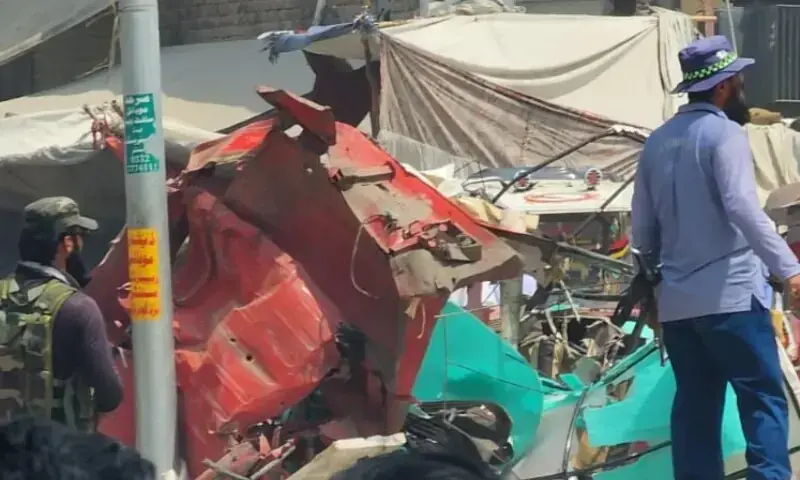
PESHAWAR - Over the past 48 hours, Khyber Pakhtunkhwa has witnessed a coordinated wave of terrorist attacks, including a devastating suicide attack on Fateh Khel Police Station in Bannu, the destruction of an important bridge near Fateh Khel, an attempted suicide attack in Jand (Attock district), and a deadly blast in the Sarai Naurang market in Lakki Marwat.
Dozens of people, including police personnel and civilians, have been martyred and injured. In Jand, a local citizen named Liaqat made the ultimate sacrifice, intercepting a suicide bomber before he could reach a security checkpoint and preventing far greater casualties.
There is a clear common factor in all these attacks. Initial evidence and past patterns indicate that these operations are being carried out by the Hafiz Gul Bahadur group and affiliated Khawarij networks of the TTP - networks that are once again active against Pakistan under the old Indian model of proxy terrorism , operating from safe havens inside Afghanistan .
After "Operation Sindoor" in May 2025, India failed to achieve its desired political, diplomatic, and psychological objectives. Pakistan's effective military response, national unity, and successful narrative limited Indian efforts on all fronts. Following this failure, India has significantly increased its use of terrorist proxies under its old, familiar strategy - to create fear, instability, and internal unrest in Pakistan.
The recent attacks in Bannu, Lakki Marwat, and adjoining areas are part of the same chain .
| India's Military Failure | India's Proxy Response |
|---|---|
| 8 Indian aircraft shot down (4 Rafales) | Increased funding to TTP/Hafiz Gul Bahadur |
| S-400 neutralized | Weaponization of Fitna al-Khwarij networks |
| India forced to beg for ceasefire | Cross-border attacks from Afghan soil |
| Diplomatic isolation | Targeting of civilian soft targets |
Pakistan's National Security Committee has previously noted that India has established a new proxy militia, the "Fitna-al-Khwarij," operating from Afghanistan to destabilize Pakistan .
The terrorists initially attempted to target hardened military installations and operational positions. However, due to the Pakistan Armed Forces' continuous intelligence-based operations (IBOs) , strong defensive positions, and effective actions, they have suffered heavy losses.
This is why these terrorists are now targeting soft targets - police posts, bridges, markets, and civilians - to spread fear and panic.
The reality is that Taliban and Indian-backed terrorists have already failed to achieve significant success against hardened military targets. As a result of this failure and frustration, they have shifted tactics:
| Previous Target Type | New Target Type |
|---|---|
| Hardened military installations | Police checkpoints (Fateh Khel, Bannu) |
| Army convoys | Civilian markets (Sarai Naurang, Lakki Marwat) |
| Secured military posts | Bridges and infrastructure |
| Armed forces personnel | Police and ordinary civilians |
The objective is clear: divert media and public attention toward the internal law and order situation, create a sense of insecurity among the population, and pressure the state from within - all without having to confront Pakistan's armed forces directly.
The Hafiz Gul Bahadur group has a long history of receiving support from Indian intelligence agencies. The network operates from North Waziristan and has maintained sanctuaries inside Afghanistan, particularly in Khost and Paktika provinces.
Key facts about the Hafiz Gul Bahadur network:
| Detail | Information |
|---|---|
| Area of operation | North Waziristan, Khost (Afghanistan), Paktika (Afghanistan) |
| Affiliation | TTP, Fitna al-Khwarij, Ittehad-ul-Mujahideen Pakistan |
| Foreign support | Indian RAW, Afghan Taliban sanctuary |
| Tactics | Cross-border infiltration, IEDs, suicide attacks |
| Recent attacks | Bannu police station, Lakki Marwat market |
The Hafiz Gul Bahadur network and its affiliated Khawarij networks are "once again active against Pakistan under the old Indian model of proxy terrorism residing in Afghanistan."
Pakistan is already continuing decisive operations against terrorist networks under "Operation Ghazab-ul-Haq" (renamed from Ghazab Lil Haq). Intelligence-based operations against terrorists and their facilitators located across the border will continue, while operations inside the country will also proceed without interruption until the complete elimination of terrorism.
Key results of the operation to date:
| Category | Results |
|---|---|
| Terrorists eliminated in Bannu (2026) | 171 |
| Terrorists injured in Bannu (2026) | 177 |
| Terrorist hideouts destroyed | Dozens |
| Cross-border infiltration attempts foiled | Multiple |
The operation has been conducted with precision, targeting only terrorist infrastructure while minimizing civilian casualties - a stark contrast to the terrorists' deliberate targeting of civilians.
In this war, not only the security forces but also the political and provincial leadership bear extremely important responsibilities. The role of political governments is not merely to issue statements, but to:
Galvanize the public against terrorism
Eliminate local facilitation provided to terrorists
Deprive these networks of social and political support
Ensure political coherence behind counterterrorism operations
It is unacceptable under any circumstances for provincial or political elements to distance themselves from this war or avoid confronting it.
The infrastructure of terrorism does not function through weapons alone. It also requires local facilitation, facilitators, financial support, and silent backing . Decisive action against all these elements at the political, administrative, and social levels is indispensable in order to weaken the roots of terrorism.
The current situation demands that the KP Police be further strengthened and hardened along modern lines. Equipping police lines, police stations, checkpoints, and sensitive installations with modern technology, protective barriers, jammers, and effective surveillance systems is an urgent necessity in order to reduce the likelihood of attacks on soft targets.
| Required Upgrade | Purpose |
|---|---|
| Protective barriers | Prevent VBIED breaches at checkpoints |
| Jammers | Disable remote-detonation IEDs |
| Modern surveillance systems | Early detection of suspicious movement |
| Hardened police stations | Minimize casualties during attacks |
| Enhanced communications | Faster response coordination |
The police are on the front lines of this war. They deserve the same level of protection and resources as the military.
This war against terrorism is not only the war of the security forces , but of the entire state and nation.
National unity, strong institutions, and continuous intelligence-based operations are the guarantee of Pakistan's success in defeating:
Indian proxy strategy via RAW-sponsored networks
Taliban-supported terrorism from Afghan soil
Khawarij networks operating under various names
The recent wave of attacks is not a sign of terrorist strength. It is a sign of their desperation .
They cannot fight the Pakistan Army. So they kill police and civilians.
They cannot breach hardened military installations. So they bomb markets and bridges.
They cannot win on the battlefield. So they try to break the nation's morale.
They will fail.
The recent attacks in Bannu, Lakki Marwat, and Attock are part of a coordinated campaign by Indian-sponsored terrorist networks operating from Afghan soil. These attacks are not signs of strength - they are the desperate acts of a dying enemy.
Pakistan's armed forces, police, and intelligence agencies have degraded these networks to the point where they can no longer target hardened military installations. In their frustration, they have turned to soft targets: police checkpoints, civilian markets, and unarmed citizens.
The nation must stand united. The political leadership must act, not just issue statements. The police must be strengthened and protected. And the fight against terrorism - Pakistan's fight, not just the army's - must continue until every terrorist is eliminated.

