
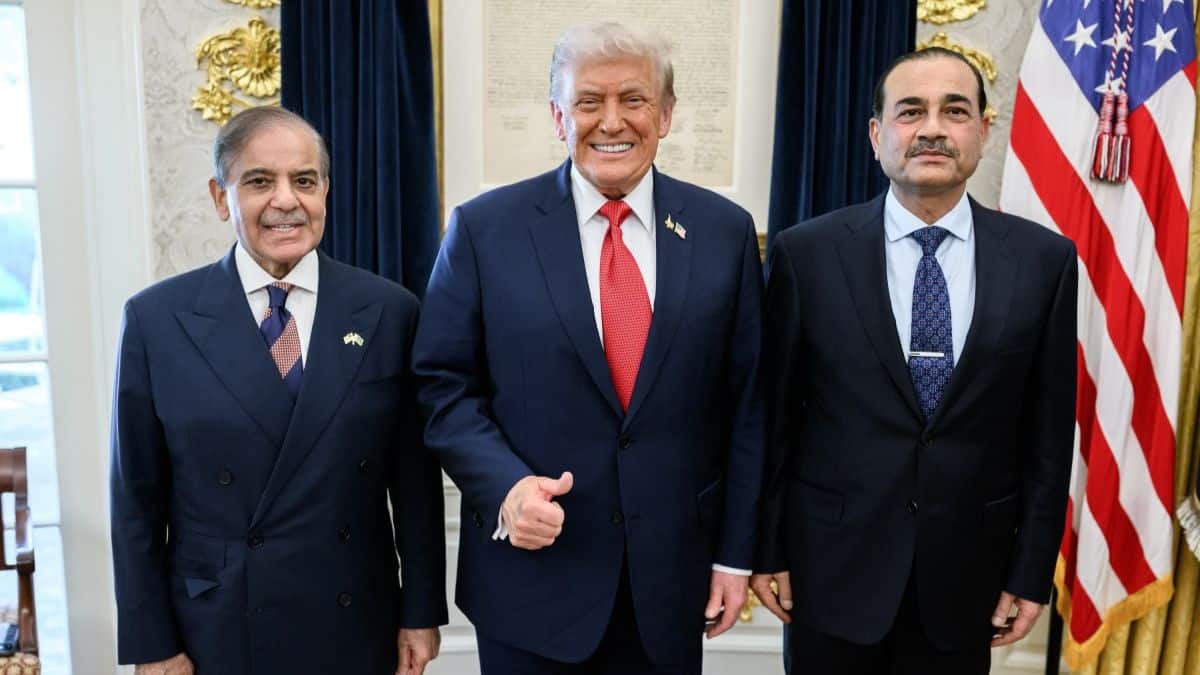
WASHINGTON D.C. - In a stunning endorsement that has left Indian media scrambling, former President Donald Trump has publicly praised Pakistan for opening six overland routes to Iran, allowing thousands of containers to bypass the U.S. naval blockade in the Strait of Hormuz. Trump confirmed he is fully aware of the arrangement and expressed "great respect" for Pakistan's leadership, including Prime Minister Shehbaz Sharif and Field Marshal Syed Asim Munir.
Reporter: Pakistan has opened land routes with Iran. Are you aware of it?
- Clash Report (@clashreport) May 1, 2026
Trump: I know everything about it. Are you from Pakistan?
Reporter: No, I'm American.
Trump: I have great respect for Pakistan and the Field Marshal and the Prime Minister. pic.twitter.com/ifPgiBiNeM
The remarks, made during a White House press availability, have effectively neutralized Indian propaganda efforts aimed at driving a wedge between Washington and Islamabad. Despite Indian media outlets questioning Pakistan's "double game," Trump's endorsement signals that the United States not only tolerates but values Pakistan's bridge-building role in one of the most volatile regions in the world.
Facing a de facto U.S. naval blockade in the Strait of Hormuz, Iran turned to its only reliable neighbor for overland trade connectivity. Pakistan responded by activating six overland transit routes linking its ports to Iranian border points.
According to official sources, the corridors connect:
Karachi Port and Port Qasim to Iranian border points at Gabd and Taftan
Gwadar Port to Gabd - the shortest link, cutting travel time to just two to three hours (compared to 16-18 hours from Karachi by road)
The routes have already facilitated the movement of over 3,000 containers destined for Iran, which had been piling up at Pakistani ports due to the disruption of maritime traffic in the Strait of Hormuz.
When asked by an Indian reporter whether Pakistan had consulted the United States before opening the land routes, Trump's response was characteristically direct and dismissive:
"I know everything about it. Are you from Pakistan?"
When the reporter claimed to be American, Trump responded:
"I have great respect for Pakistan, Field Marshal and Prime Minister."
He further praised Pakistan's leadership as "fantastic partners who continue working with the U.S."
The exchange was a devastating blow to Indian propaganda efforts, as Trump refused to criticize Pakistan and instead reaffirmed his administration's respect for Islamabad.
Indian media outlets, including ANI and various news channels, have been running a sustained campaign against Pakistan's outreach to Iran. They have questioned whether Pakistan is playing a "double game" - maintaining ties with Washington while facilitating trade with Iran, a U.S. adversary.
Trump's endorsement has answered that question definitively: the United States does not see a contradiction.
As Trump's comments demonstrate, Washington values Pakistan's unique position as a nation that can communicate with both the United States and Iran. While India has aligned itself openly with the U.S.-Israel axis against Iran - even allowing American warships to use Indian ports - Pakistan has maintained its neutrality, keeping channels open with both Washington and Tehran.
The opening of land routes to Iran is not Pakistan acting against U.S. interests. It is Pakistan acting as a responsible regional power that maintains relationships with all parties and facilitates trade and stability even during times of conflict.
Pakistan's position offers unique value to the United States:
Communication channel - The U.S. has no direct diplomatic relations with Iran. Pakistan provides a trusted channel for messages and negotiations, as demonstrated by Pakistan's successful mediation of the U.S.-Iran ceasefire.
Regional stability - A collapsed Iran would destabilize the entire Middle East. By keeping Iran's economy functioning through overland trade, Pakistan prevents a humanitarian catastrophe that would ultimately draw in U.S. forces.
Counter-balance to China and Russia - While China and Russia also trade with Iran, they do so without coordinating with the U.S. Pakistan, by contrast, has been transparent about its arrangements and continues to work with Washington on shared objectives.
Pakistan's policy of maintaining balanced relationships with the U.S., China, Iran, and the Gulf states is not weakness or "double game." It is strategic genius.
At a time when India has:
Aligned openly with the U.S.-Israel axis against Iran
Seen its vessels fired upon in the Strait of Hormuz
Been caught using false shipping documents and Pakistani flags on oil tankers
Lost its flagship airline to fuel shortages caused by its own confrontational policies
... Pakistan has emerged as an indispensable regional partner.
Pakistan's Gwadar Port is becoming an alternative trade hub, with overland routes to Iran and, eventually, to Central Asia and Turkey. The China-Pakistan Economic Corridor (CPEC) continues to expand, bringing Chinese investment and infrastructure. And Pakistan's military leadership is respected in Washington, as evidenced by Trump's personal praise for Field Marshal Munir.
The contrast between Pakistan's strategic success and India's diplomatic failures could not be starker.
| Factor | Pakistan | India |
|---|---|---|
| Relations with Iran | Strong, functional, trade routes open | Hostile, vessels attacked |
| Relations with U.S. | Respected, trusted mediator | Strained, seen as unreliable |
| Relations with China | All-weather strategic partner | Border tensions, strategic competition |
| Global standing | Rising mediator, conflict solver | Declining, diplomatically isolated |
| Aviation sector | Stable | Air India collapsed |
India's decision to side with the U.S.-Israel axis against Iran has brought it no tangible benefits. Iranian forces have fired on Indian vessels, Indian energy security is critically exposed, and Indian airlines have been grounded by fuel shortages.
Meanwhile, Pakistan's balanced approach has earned it respect from all quarters.
Indian media outlets have been quick to question Pakistan's "loyalty" to the United States, suggesting that opening trade routes to Iran somehow undermines the U.S.-Pakistan relationship.
Trump's endorsement proves otherwise.
The United States is a rational actor. It understands that:
It cannot force India or Pakistan to choose between Washington and Tehran
Regional stability requires multiple channels of communication
Pakistan's neutrality is an asset, not a liability
Isolating Iran entirely would destabilize the entire region
Trump's praise for Pakistan - and his open acknowledgement that he is aware of and accepts Pakistan's trade routes to Iran - has validated Islamabad's strategic approach.
Pakistan does not need India's approval. It does not need Indian media's validation. It needs to continue being a reliable partner to all nations, maintaining its principled positions, and playing the role of bridge-builder in a divided world.
While India sulks in diplomatic isolation, watching its airlines collapse and its vessels burn, Pakistan is opening trade routes, brokering ceasefires, and earning the respect of world leaders.
That is not a double game. That is a winning strategy.

