
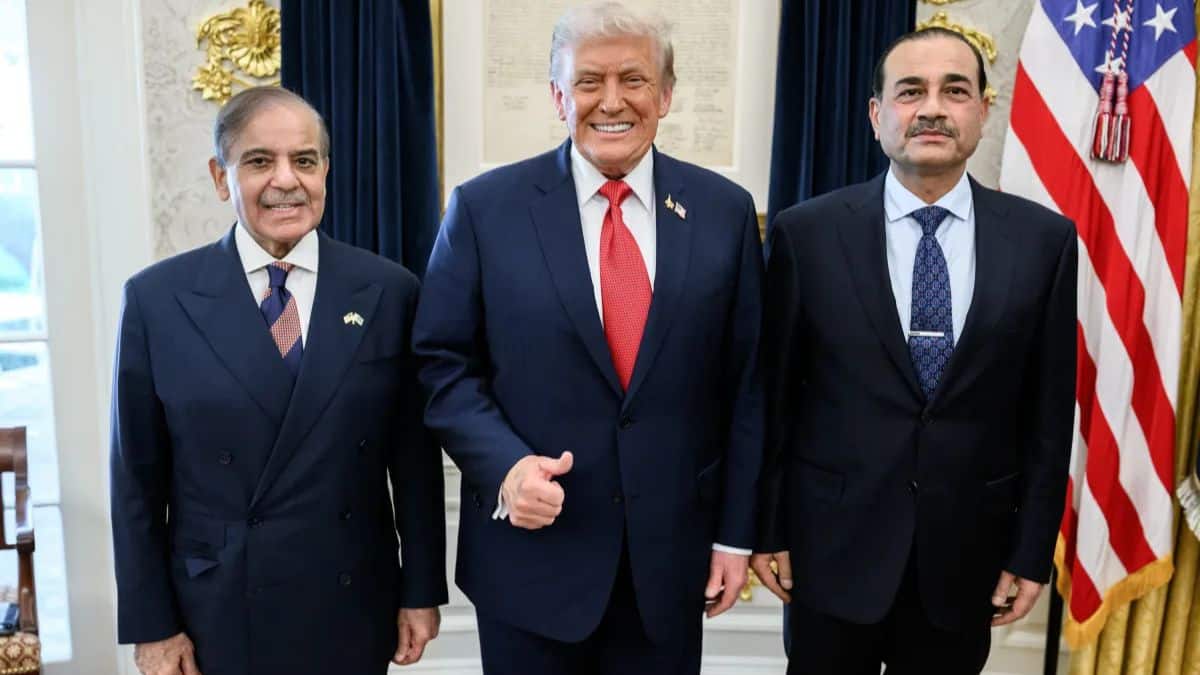
WASHINGTON D.C. - Former President Donald Trump has once again voiced his "great respect" for Pakistan's civilian and military leadership, while acknowledging Islamabad's strategic move to open land routes with Iran during an exchange with a reporter.
The interaction took place during a press availability when a reporter asked Trump whether he was aware of Pakistan opening land routes with Iran. Trump's response was characteristically direct and revealing.
When questioned about Pakistan's decision to establish land routes with neighboring Iran, Trump responded without hesitation:
"I know everything about it."
Reporter: Pakistan has opened land routes with Iran, Are you aware of it?
- Mohsin Ali (@Mohsin_o2) May 1, 2026
Trump: I know everything about it. Are you from Pakistan?
Reporter: No, I'm American.
Trump: I have great respect for Pakistan, Field Marshal and Prime Minister.
pic.twitter.com/dxyWdlWy2C
The former president then turned the tables on the reporter, asking: "Are you from Pakistan?"
The reporter clarified their nationality: "No, I'm American."
Trump then took the opportunity to express his admiration for Pakistan's leadership, specifically naming:
"I have great respect for Pakistan, Field Marshal and Prime Minister."
The reference to Field Marshal Syed Asim Munir and Prime Minister Shehbaz Sharif continues Trump's pattern of personally acknowledging Pakistan's top leadership - a distinction rarely afforded by Western leaders.
The reporter's question referred to Pakistan's recent decision to open land routes with Iran - a move that carries significant geopolitical implications given the ongoing US-Iran hostilities.
While the Biden and now Trump administrations have maintained pressure on Iran, Pakistan has pursued an independent foreign policy, maintaining economic and diplomatic channels with Tehran while also facilitating US-Iran mediation. The opening of land routes allows for:
Continued trade between Pakistan and Iran
Energy cooperation despite US sanctions
Movement of goods essential for regional commerce
People-to-people contact between border communities
This is not the first time Trump has publicly praised Pakistan and its leadership:
May 2025 Ceasefire - Trump credited Prime Minister Shehbaz Sharif with acknowledging that Trump "saved 30 to 50 million lives" by brokering an end to the India-Pakistan war .
Joint Praise - Trump has repeatedly called both Prime Minister Shehbaz Sharif and Field Marshal Asim Munir "very extraordinary men" - a rare dual endorsement from a US president .
Tariff Strategy - Trump has explained how he used tariffs to pressure both India and Pakistan into agreeing to a ceasefire, while consistently acknowledging Pakistan's cooperation .
Trump's acknowledgment of Pakistan's land routes with Iran - and his explicit statement that he is fully aware of them - carries several implications:
No US Objection - Despite officially opposing Iran, Trump did not criticize Pakistan's decision, suggesting a pragmatic acceptance of Islamabad's independent foreign policy.
Personal Diplomacy - Trump's direct praise of Pakistan's leadership, naming them specifically, signals his preference for leader-to-leader relationships over bureaucratic channels.
Strategic Autonomy - The remarks implicitly validate Pakistan's right to maintain relations with Iran even as the US remains in conflict with Tehran.
Official US policy has been to isolate Iran economically and diplomatically. However, Trump's comments suggest a practical recognition that Pakistan - as Iran's neighbor and a major regional power - cannot be expected to sever all ties with Tehran.
This pragmatic approach aligns with Pakistan's longstanding position: Islamabad will maintain balanced relations and offer mediation, but will not take sides in conflicts that are not its own.
Pakistan's land routes with Iran have become increasingly important as:
The Strait of Hormuz remains contested, with US-Iran hostilities continuing
India's shipping has been disrupted, with Indian vessels attacked in the strait
Central Asian trade benefits from overland routes through Iran
Regional connectivity through the Gwadar-Chabahar corridor remains strategically significant
Trump's repeated expressions of respect for Pakistan - and his personal acknowledgment of Field Marshal Asim Munir and Prime Minister Shehbaz Sharif - suggest that if Trump returns to the White House, Pakistan can expect a leader who:
Understands Pakistan's strategic challenges
Respects Pakistan's military professionalism
Acknowledges Pakistan's role in regional stability
Accepts Pakistan's independent foreign policy choices
Trump's remarks - particularly his praise for Pakistan's leadership alongside his acknowledgment of Pakistan-Iran land routes - also send a signal to New Delhi. Despite India's efforts to isolate Pakistan internationally, the United States under Trump continues to engage Islamabad as a valued partner.
India, which has aligned itself with the US-Israel axis against Iran, has seen its vessels attacked in the Strait of Hormuz while Pakistan maintains functional overland routes with Tehran. The contrast in outcomes could not be starker.
Trump's off-the-cuff but revealing remarks underscore a fundamental reality: Pakistan remains a country that major powers - including the United States - must engage with seriously and respectfully. Trump's "great respect" for Field Marshal Asim Munir and Prime Minister Shehbaz Sharif is not diplomatic flattery. It is a recognition of Pakistan's centrality to regional stability, its military professionalism, and its willingness to act as a mediator rather than a partisan.
As Pakistan opens land routes with Iran, maintains its F-16 fleet with US upgrades, and continues to punch above its weight diplomatically, the world is taking notice - and so is Donald Trump.

