
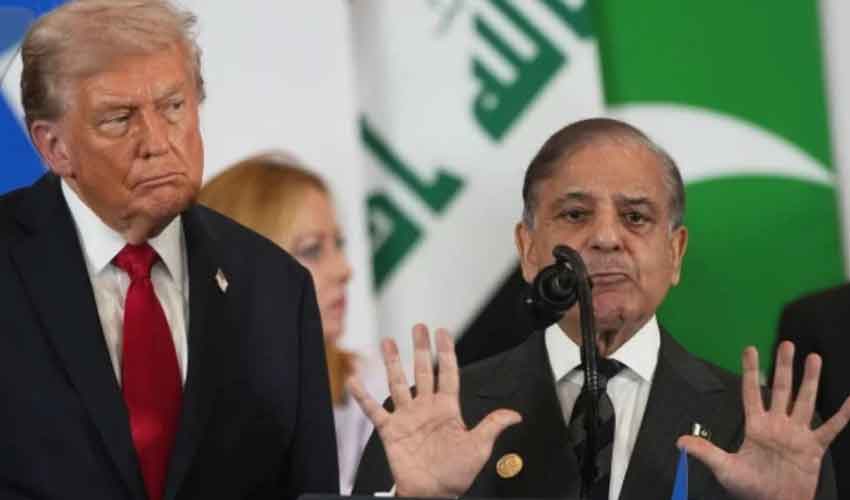
WASHINGTON D.C. - President Donald Trump has confirmed that the United States suspended the military escort mission known as Project Freedom at the specific request of Pakistan's civilian and military leadership, praising Prime Minister Shehbaz Sharif and Field Marshal Asim Munir for their role in advancing diplomatic negotiations with Iran.
🚨🇵🇰 PAKISTAN AURA IS NEXT LEVEL
- Zard si Gana (@ZardSi) May 8, 2026
US President Trump says he suspended Project Freedom because of Pakistan’s leadership Field Marshal and Prime Minister, he says:
“Wonderful leadership of Pakistan asked me not to do it, go for negotiations”
Bad news for Indians continuously. pic.twitter.com/KDbGUFG1Jw
Responding to a reporter's question about why the operation - previously described by administration officials as the "next phase of the war" - had been put on hold, Trump credited Islamabad directly.
"Because the really wonderful leadership at the place. As you know, Pakistan has been fantastic, and their leaders have been fantastic - the Field Marshal and the Prime Minister - and they asked us not to do it," Trump told reporters.
He added: "We'll go back to it if we have to. They asked us not to do it during the negotiation."
Project Freedom: A Recap
Project Freedom was announced by President Trump on May 3, 2026, as a U.S.-led military operation to escort commercial ships through the southern route of the Strait of Hormuz. The operation involved guided-missile destroyers, over 100 land and sea-based aircraft, and approximately 15,000 service members.
Two American-flagged merchant vessels successfully transited the strait with U.S. Navy destroyer support on May 4, marking the first such passage since Iran effectively halted commercial traffic on April 18.
The operation was subsequently suspended following the ceasefire brokered by Pakistan between the United States and Iran.
Pakistan's Mediation Role
Pakistan has emerged as the key facilitator in U.S.-Iran negotiations, following the ceasefire brokered by Islamabad on April 8. The first round of direct talks was held in Islamabad on April 11-12, marking the first direct dialogue between the two adversaries in nearly five decades.
Field Marshal Asim Munir, Chief of Army Staff, and Prime Minister Shehbaz Sharif have been personally engaged in the mediation process, with Munir reportedly holding multiple direct conversations with President Trump during the negotiation period.
The suspension of Project Freedom is widely viewed as a confidence-building measure requested by Pakistani mediators to create a less provocative environment for continued talks.
A Blow to Indian Strategic Hopes
Observers note that Trump's public acknowledgment of Pakistan's influence over U.S. policy in the region represents a significant diplomatic setback for India, which has consistently opposed any third-party mediation in regional disputes and viewed the U.S.-Iran conflict as an opportunity to isolate Pakistan internationally.
The development also underscores Washington's growing reliance on Islamabad as a regional diplomatic partner, even as India remains a key U.S. ally in the Indo-Pacific.
What Comes Next
President Trump's remarks suggest the suspension of Project Freedom is temporary and conditional on continued diplomatic progress.
"We'll go back to it if we have to," he warned, leaving open the possibility of resuming military escorts if negotiations with Iran fail.
For now, Pakistan's leadership has successfully leveraged its unique position as the only nation with direct communication channels to both Washington and Tehran - a diplomatic asset that continues to pay strategic dividends.

